© Jane Schy 2024
First published 16th August 2022
I started researching this hotel in early 2021. How interesting it was to discover that there were two hotels with the name “Rising Sun” in the Rosewood township, and that they were situated not too far away from each other. It has been personally satisfying to have pinpointed the location of the first hotel and reveal its history to the community.
The first Rising Sun Hotel started operating in December 1857 in a large, wooden, two-storey building. Michael O’Brien built it on his land (Portion 11 on the map) situated at the end of School Street and on the other side of the Ipswich-Rosewood Road (the old Toowoomba road). It was built on the highest part of the land, and although encroached upon many times by floodwater, it remained dry. Jane McGeary’s six acre block was next door. Only once have I seen the Rising Sun referred to as the “Sunrise” and sometimes the locals referred to it as “O’Brien’s Hotel”.

It was described by William Pitt Vance, the son of John William Vance, one of the earliest pioneers. William was born in 1868. In 1923 he wrote to the Daily Mail about his boyhood memories of what was then known as Rosewood Gate. My dearest memories are of two small clearings where the town now stands, and a strip of scrub with a track cut in it (now the main street), and the old home, slabs and shingle roof, and over across the forest, on the main road to Toowoomba, a large two-storied hotel, where the coaches used to stop prior to the railway coming.
Pughs Almanac of 1866 says The White Lion Inn, Moore’s, is 7 miles on the road from Ipswich, and the Rising Sun, at Rosewood, is 14 miles on. (On 7th April 1860, Frederick Moore was granted the license for the “White Lion Inn” at Seven Mile Creek.)
Henry George McGeary’s obituary (1939) gave information about his father Henry. He later purchased O’Brien’s Hotel, a building on Toowoomba-road near where the McGeary home now stands, and converted the bar portion into a butcher’s shop. Then he built a shop in John-street, Rosewood. The McGeary home still stands there.

On page 2 of the Northern Australian dated 21st July 1857, Michael O’Brien advertised to sell 98 acres 2 roods 26 perches and a four-roomed cottage at Seven Mile Creek. The cottage was described as well shingled with a good kitchen, large back yard, a shed, milking yard and a good fenced garden, with a pig-proof fence of 270 rods.
Michael moved his family to a two storey residence he had built on his land on the old Toowoomba road near Rosewood, and he opened a wayside inn, a hotel. There were gardens on one side of the hotel and a stock yard on the other. See Railway Map

1st December 1857 – A license was granted to Michael O’Brien, owner of the Rising Sun Hotel, Rosewood.
20th April 1858 – Michael O’Brien’s license was renewed for the Rising Sun Hotel.
Hotels were used for many purposes other than the provision of liquor and accomodation. All sorts of business was conducted at these venues because they were usually central to the district and provided the space needed for gatherings.
In August 1858, an inquest was held on the body of a man named Adam Babel, who had been employed as a shepherd at Rosewood Station. For a long time past had been suffering from pulmonary disease. From the evidence it appeared that his employer had sent him in a cart to Ipswich so he could be forwarded to the Brisbane Hospital for treatment. On the road he become worse. On arriving at O’Brien’s public house he wanted to stop for the night, but O’Brien most cruelly refused to admit him, and so the cart continued on with him for two or three miles further. The driver, hearing some inarticulate sounds, turned to look at Babel, who was trying to communicate with him by signs. In a few minutes he died. The evidence of Dr. Lucas, who made a post mortem examination of the body, showed that the immediate cause of death was effusion into the cavity of the pleura. [1]
14th September 1858 – Michael O’Brien was charged with illegally refusing to accommodate a traveller. He was fined but did not appear in court.
Michael’s wife Margaret made a complaint about a man named William Darker for using insulting and obscene language to her on the public road near her house at the Rosewood Scrub. He was bought before the magistrate where he pled guilty and was sentenced to three months’ imprisonment in Brisbane jail.
7th April 1860 – Phoebe Cook was granted a license for the Rising Sun. Phoebe Cook née James was born in 1787 in Kingston Seymour, Somerset, England. She married John Cook in 1813 in Bristol. She was a widow, aged 67, when she immigrated on the Ramillies to Sydney in 1855. Phoebe was also the licensee of the Postman’s Arms (Jockey Club Inn), Grandchester in 1867 and died there in 1872.
3rd August 1860 – Michael O’Brien was summoned for keeping up a sign without having a license and selling spirituous and other liquors. His name was written under the sign “Rising Sun” but his name had been painted over and the name of Phoebe Cook was painted over the door instead. The charges were dismissed.
The “North Australian” records a severe and fatal accident at Rosewood Scrub. The particulars are as follows:- As a bullock-dray was proceeding to Drayton yesterday at the Rosewood Scrub, in care of a driver named Gill, in going down a creek it was unfortunately capsized, and a boy named Connolly who was riding on it was crushed to death instantly, and Mrs. Connolly, his mother, was likewise precipitated out of the dray, and probably under the wheels, as she had her arms and legs broken. They were then removed to the Rising Sun public-house at Rosewood where an inquest would be held on the body of the boy. [2]
16th April 1861 – Frederick Lloyd from Gatton was granted a license for the Rising Sun. Frederick was born about 1821 in London. He later ran a store in Gatton.
LOST from ROSEWOOD, a CHESTNUT HORSE, white down the face, branded W2 near shoulder. Any person delivering the same to JOSEPH COOK, Gatton; or to the undersigned, will receive the reward. F. LLOYD. Rising Sun Inn, Rosewood, January 2, 1862.
15th April 1862 – Frederick Lloyd’s license for the Rising Sun was renewed and then transferred to Joseph Cook. (Son of Phoebe Cook mentioned above.) Joseph was also a mail contractor at Gatton.
24th October 1863 – Michael O’Brien applied for the license of the Rising Sun again. He said he was the proprietor of the hotel, which contained two sitting rooms and six bedrooms, exclusive of those which would be occupied by his wife and family of eight children. He said it had previously been occupied by Joseph Cook, but had been closed since the 1st of July last. This license was granted 12th November.
In March 1864 there were floods, the highest ever experienced. A large party of road workers, who for some months had been engaged in forming and making a road between the Seven Mile Bridge and the Rising Sun Inn, were camped on the paddock behind the hotel. It was covered by 4 ft of water. The hotel escaped because it was situated on the most elevated part. The stockyard-fence at O’Brien’s was knocked down, and a horse, with a bridle and saddle on, was carried away and drowned. The whole of the country from the Seven Mile to Rosewood was immersed, inflicting great damage to the settlers in the district.
19th April 1864 – Michael O’Brien applied for renewal of his license. A man named Charles Clay was a barman at the hotel at the time.
In July, Mr. Fraser’s coach, which left Toowoomba for Ipswich on Wednesday morning 13th, turned over near the hotel. The accident was caused by one of the horses falling as they wore floundering through the thick, black mud which was overly abundant after a little wet weather in the neighbourhood. Fortunately no one was hurt because the Hon. A. Macalister, Minister for Lands and Works, was one of the passengers. It was hoped that his experience might lead to the improvement of the roads, as it was hard to imagine he would have enjoyed being amongst those crawling out of the filth like a lot of little pigs out of a slough.
The following year or so was reminiscent of the untamed nature of the Wild Wild West.
The Queensland Times, Ipswich Herald and General Advertiser ran this story on Tuesday 26 April 1864 on page 3
IPSWICH POLICE COURT. Saturday, April 23.
Andrew Hanrahan, a constable in the Ipswich Police Force, was charged before Messrs. Panton and Hutchinson, with having at the Rosewood on the 14th instant, been guilty of a gross neglect of duty. Mr. Batho appeared for the defendant.
Joseph Platz said that on Monday, the 14th inst., a man named John George Campbell committed a rape upon his daughter, a girl under the age of 12 years. The girl reported the occurrence to him. He then went in pursuit of the offender, whom he overtook at the Rosewood. He asked the barman of the Rising Sun hotel to assist him in arresting Campbell; but the barman said he was only a civilian. He advised Platz to get a constable. He went away, and while on the road to Ipswich he met Kyran Walsh, who told him a constable had just passed up towards the Rosewood. He returned, and at the inn he found Hanrahan. He told the constable what Campbell had done, and pointing him out, asked him to apprehend the man. Hanrahan said, “I know the prisoner well, and can get his camp any moment. Go for a warrant and I will have my eye on him.” When Campbell heard what had passed he went off the verandah, and mounting his horse rode away. Hanrahan made no effort to prevent him leaving. Platz then left, proceeding towards the Seven-Mile Creek. He met Constable Bodel on the road, and made him acquainted with the particulars of his complaint against Campbell and Hanrahan’s refusal to apprehend him. Bodel said, “Come and point out the man and I’ll take him in charge.” They returned, but could not find Campbell.
Charles Clay, barman at the Rosewood Inn, said that on the 14th of the present month he saw Platz and a man named Campbell at the Rosewood. Platz was in a state of great excitement and he could not understand what he said. He did not ask him to assist in taking Campbell in charge. He heard Platz afterwards complain about something to Hanrahan, but what he said was unintelligible. He did not see them; he only heard. He did not hear him direct Hanrahan to take the prisoner into custody. He did not hear the reply. He saw Campbell leave; he rode away as fast a he could. As far as he was aware, Campbell left as Platz was “’yabbering” to the constable.
This witness, in his evidence, contradicted himself several times, and drew from Mr. Panton the remark that his testimony had no weight with him.
John M’Cormack, bailiff of the Court of Requests, Ipswich, said he was present when Platz came up to Hanrahan. Platz seemed to be excited. He pointed to Campbell and said, “Take that man in charge.” He made some statement, but what he said could not be understood. Hanrahan asked him to state what he had to say calmly; but Platz would not keep quiet. He was very much excited, and was striving hard to speak English. Witness asked if he saw Campbell do anything. Platz said he did not. He was present, but did not hear all that passed. After Campbell was gone Hanrahan advised Platz to come to Ipswich and obtain a warrant. Hanrahan said witness left the Rosewood together, about a quarter of an hour after Campbell went away. Campbell left two minutes after Platz pointed him out.
By Mr. Batho: Hanrahan appeared to do all he could to ascertain the nature of the charge which Platz had against Campbell.
Sergeant Gunn, of the Laidley Police, was next examined, and said that Hanrahan never mentioned anything of what had taken place at the Rosewood until he received instructions to apprehend Campbell. In is opinion Hanrahan was not called upon to do so immediately on his arrival at the police station.
Constable Bodel said it was only through the assistance of another German that he could gather the nature of Platz’s complaint. He would not have been able to understand Platz without such assistance.
For the defence, Mr. Quinn, chief constable, testified to the excellent character which Hanrahan had borne up to this time. The Bench took the evidence of good character into consideration and fined Hanrahan 20s.
There was another incident in June 1864 when Michael Purtell, Daniel Sullivan, James Kinane, John Quinlan, Stephen Ryan, Thomas Conroy, and John Sullivan were charged with being guilty of riotous conduct. Michael O’Brien said it was the worst to date. Read about it here.
11th July 1865 – A renewal of the license for the Rising Sun was granted to Michael O’Brien.
Before the Police Magistrate on 22nd September 1865, Michael Hourigan was brought up for having unlawfully assaulted Thomas Heffernan. Sergeant Johnson had arrested Hourigan at Little Pocket on the 12th. He had evaded the police for eight days, and when Sergeant Johnson spotted him he tried to escape across a paddock, but was caught and confined in the lock-up. Thomas Heffernan said that he was with Hourigan and three other men at O’Brien’s public-house at the Rosewood Scrub on the 1st, and they had a few glasses each. An altercation took place outside about horses, during which Hourigan wanted Heffernan to fight him. Heffernan refused to fight and went inside the hotel and later had a word to him about the way he was behaving. A squabble then took place between Hourigan and a man named Shea. Heffernan tried to stop them from fighting and Hourigan then took hold of him. They struggled and both fell. They got up, exchanged a few blows, and fell again, Hourigan landing under Heffernan. Hourigan then put his hands round Heffernan’s head, pulled him down, and bit off a portion of his lip. Heffernan ran into the hotel and Hourigan threw two stones at him as he ran, one of which broke four panes of glass. Heffernan had his wound tied up with a handkerchief and went to town and had it dressed by Dr. Dorsey. The portion of the lip bitten off was not restored, but it had been found. William McTaggart Dorsey deposed that when Thomas Heffernan came to him, a portion of his lip was missing, and the gap left was about the size of a small mouth, extending from the top of the lip to the union of the lip with the chin. Dorsey said he joined the lip by a surgical operation and it was progressing favourably.
Michael O’Brien, publican, corroborated the evidence and added that the parties were not drunk, though the effect of liquor was noticeable on them. His man found the piece that had been bitten from the lip about five yards from where the scuffle took place. The prisoner had no defence and was committed for trial. Bail was allowed in the amount of £80, two sureties of £40 each. At the trial, the jury returned a verdict of guilty, with a recommendation to mercy, and Hourigan was sentenced to six months’ imprisonment with hard labor in Brisbane gaol. His wife, who was in court, fainted when she heard the sentence.
Michael became insolvent. In April 1866 he didn’t apply to renew his license at the annual licensing board’s meeting. A promissory note for £1,643.19s was signed by him on the 8th June 1867 in favour of Cribb & Foote, Ipswich. It was payable nine months later together with with interest of 12 per cent. Michael didn’t honour this agreement, apart from £600, which he paid. Michael and his family left Rosewood and went to Roma where he bought a property named “Tinowon Station” near Yeulba, and became a successful grazier. Cribb & Foote then owned his Rosewood Gate property, including the house known as the Rising Sun Hotel.
In September 1867, a lad started off on horseback near the former hotel and tried to race a train. After going some two or three hundred yards alongside the train, the horse ran him against a tree, cutting his face very badly and breaking one of his arms. The lad wasn’t named in the report, and no doubt he wasn’t the first to be tempted to pit a pony against an iron horse since the line opened in 1865.
As it was vacant, the old hotel was used as a residence until September 1870, when Cribb & Foote gave a portion of their premises formerly known as O’Brien’s Hotel for a provisional school. The school was opened in a matter of days under the management of a teacher appointed by the Board of Education (Walter Hore).
A correspondent for the Ipswich Observer and West Moreton Advocate wrote: The place that in former times was the scene of many a drunken brawl and Bacchanalian orgy, and where simple shepherds were wont to knock down their cheques in the orthodox fashion, is now transformed, as if by the wand of a magician, into a very serviceable school house and teacher’s residence; and the magician who effected this sudden change is no other than the Honorable Arthur Macalister—the chairman of the Board of Education.
The property was later purchased by local butcher Henry McGeary, who used the bar as a butcher’s block. The old unoccupied hotel building burned down at 3 o’clock on the morning of Tuesday 4th December 1888. The origin of the fire was unknown. A kitchen, about 20 yards (18.2m) away from the house, was used by five men to camp in, and they didn’t see anyone in the building at the time. Henry had it insured for £100.
So in the intervening years between 1866 and 1874, no hotel was operating under the name of the Rising Sun.
The second Rising Sun Hotel was situated on land (Portion 274 – 55 acres, on the map above) belonging to James Ryan, a butcher. It stood on the land in a slightly different position to where the present day hotel stands at 27 School Street, Rosewood.
13th October 1874 – James Ryan was granted the license for a hotel situated at Rosewood Gate. In the newspaper notice of his intent to apply for a license (at left) it was stated that he intended to call it the Rosewood Hotel. Almost immediately it was referred to as the Rising Sun Hotel. Additionally, there was already a “Rosewood Hotel” at Walloon owned by Henry Tinsley, which opened in December 1871 near the Walloon railway station. When James Ryan renewed his license, it was granted for the Rising Sun Hotel at Rosewood Gate.
John Ward was a labourer employed by James Ryan at the hotel. He was in the habit of sleeping in one of the front rooms and used his own blankets. In the mornings he rolled his clothes in them and put them under a bench on the verandah. A belt which was inside, contained seven £1 notes and a half-sovereign. Late one Saturday night in December 1874, he found them missing. He complained to James Ryan’s wife Elizabeth the next morning, and after she gave him some information, Constable O’Brien was sent for. It was ascertained that the suspect was a labourer who worked for Mrs. Duncan at Seven Mile Creek. John Ward and the Constable went to Mrs. Duncan’s house and found Daniel Maud there in a back room, and he was in possession of the missing property (one pair of tweed trousers, one pair of corduroy trousers, one striped crimean shirt, one digger’s belt, one pair of blue serge trousers, one dark tweed waistcoat, one red flannel under shirt, one patch-work quilt, one green felt hat, one cross-striped crimean shirt, one Scotch cap, a towel, and one blanket). When the matter was heard in the Ipswich Police Court, Daniel Maud said that he was drunk on the evening in question, and did not know whether he took the articles or not. The Bench sentenced him to seven days’ confinement in the lockup.
Rev. Father Horan started celebrating Mass at the Rising Sun Hotel around 1875. This venue continued to be used for this purpose throughout the years until the first St Brigid’s Catholic Church was built in 1885. Father Horan stayed at the Moran home in Railway Street when he visited the township.
On St. Patrick’s Day in 1876 the two longest trains that over ran on the Southern and West railway passed through Rosewood Gate. The local correspondent reported: I guessed there were nearly one thousand people. The train from Brisbane waited here until the 11.20 should arrive, and this delay gave me an opportunity of reviewing the company. “Tho’ on pleasure they were bent,” they “had no frugal mind.” Our worthy publican and his wife had as hard work as they could wish for in quenching the thirst of their numerous customers. The prevailing decoration was of a verdant hue. My wife tells me that green is a trying colour for the complexion. Having somewhat sombre and neutral tastes myself, I do not wear the colour, and to be sure if I did, my complexion, like Henry the Fifth’s, is past spoiling. My ears were more affected than my eyes, by the music discoursed by two rival bands in the same train-one brass, t’other bagpipes.
I was also in close proximity to a profusely decorated artist, of splendidly developed chest and throat, who was performing on a cunning instrument with immense vigour. It was with no desire to stop the harmony, or to interfere with his innocent gratification that I got him a copious “beer.” Still, it had the effect of suspending the sound, and of mellowing it when he resumed. I was sorry I could not see and hear more of my friend, but I am always lucklessly in the minority, and had to go tho other way.
2nd February 1877 – A man named Peter Carroll indecently exposed himself in the Rising Sun Hotel to Elizabeth Ryan and Elizabeth Larkin, a servant. When he was reprimanded for it he pulled out a knife and threatened the Ryans. The Bench found him guilty and he was sentenced to fourteen days’ imprisonment in Brisbane gaol with hard labour.
13th February 1877 – James Brady J.P. bought a 55 acre farm from James Ryan for the sum of £500. Included on the land was an old house, the Rising Sun Hotel, which was said to be old and of very little value. In March James Brady accepted the tender of John Farrelly (£230) for alterations and repairs to the hotel including a new bar, store and corn shed. James Ryan stayed at the hotel and ran it for Brady until 13th March when the license was transferred to Thomas Adolphus Kelleher, a school teacher from Alfred.
Mr. Kelleher, the landlord of the Rising Sun, has a very good building erected for a store adjoining his hotel. (July 1877)
13th July 1877 – The Rosewood races took place at the Rosewood Gate in a fine paddock belonging to Mr. Kelleher. The course was not very even, but it was as good as any to be found in the district; and although it was composed of black soil the rain which had fallen did not soften it much. The morning was rather gloomy, which no doubt kept a great many intending visitors at home. Never the less there was a good sprinkling of’ the fair sex, local residents, and sporting friends. Several lovers of the turf arrived from various parts of West Moreton and entered their horses to make a good day’s sport. About 250 people were on the field. Towards noon the sun shone out, and all went off as merry as possible. Our old friends Ash and Kuder were present with abundant supplies of apples, lollies, cakes, &c.; “Aunt Sally” was there, and the owner did his best to make people try and break the pipe in her mouth. Mr. Kelleher, of the Rising Sun Hotel, had a booth, in which he dispensed the best brands of wines and spirits. This gentleman deserves great credit for the able manner in which he acted as secretary and treasurer, and, in fact, for his exertions in getting up such a good day’s racing. [3]
Thomas Kelleher was readmitted to the Department of Public Instruction and went back to teaching. John Madden, who was James Ryan’s brother-in-law, leased the hotel and became the licensee in February 1878.
18th March 1878 – Daniel Ford obtained £1 on false pretences from John Madden. Ford had two drinks at 8d. each and asked to change a £1 note. Madden gave him 19s.6d. change and put the note in his pocket. Ford had more drinks and spent 5 shillings altogether and took a bottle of rum with him when he left the hotel. A little later John Madden examined the note and discovered that it was marked “£100”. Madden found Daniel Ford near the railway gate and asked him about it. Ford said that it was a “good one” and that the station master at Dalby had given it to him. The Bench found Ford guilty and sentenced him to one month’s imprisonment with hard labour in Brisbane goal.
6th July 1878 – James Brady sold 7 business sites immediately opposite the Rosewood Gate including the Rising Sun Hotel and six adjoining lots. (Advertisement) Brady had been getting good rent (£50 a year) for the hotel and it was advertised as commanding the best position of any country hotel in the Colony. James Ryan bought back the hotel and adjoining lots and John Madden retained the lease of the hotel.
Later that year tragedy struck the hotel on Friday, 22nd November.
A fire took place at Rosewood Gate last night which resulted in Madden’s hotel, a store, and two barns being burned down in half an hour. Other houses in the neighbourhood were saved with difliculty. The fire is supposed to have been caused by the careless handling of a candle in one of the bedrooms. Bush fires are raging in the neighbourhood, but the fire is in no way referable to them. The property destroyed is uninsured, except to the extent of £300 on the buildings, and the salvage will be very small. It is expected that the total loss will reach £1,000. [4]
FIRE. During the thunderstorm that raged on Friday evening last in the Rosewood district, the Rising Sun Hotel, at Rosewood Gate, was destroyed by fire. It is supposed that the building was struck by lightning, as no other cause for conflagration can be assigned. The fire occurred shortly after half-past ten o’clock, and within a quarter of an hour from that time, the building was laid level with the ground; being constructed , almost entirely of wood, it burned like tinder, while the spirits in the bar and storeroom added materially to the rapid demolition of the structure. At one time great fears were entertained for the station house, but, luckily, the flames were entirely confined to the premises on which they first broke out. The hotel was the property of Mr. J. Ryan, and its original cost was about £625, but we regret to learn that the owner was only partly insured to the extent of £300. The tenant, Mr. J. Madden, is also a very severe sufferer, as he has lost all his furniture, fittings, and the entire stock in trade, which had only just been replenished, the loss falling on him being about £200, uninsured. The residents around did all they could to save the contents of the buildings, but the flames spread with amazing rapidity, and there was no chance of saving anything. To losers by this sad and sudden calamity we offer our deepest sympathy, as the hotel was a well-constructed building, and one much appreciated by travelers, while during his tenancy Mr. Madden had deservedly gained the reputation of being an excellent landlord. [5]

Mr. John Madden
James Ryan immediately set about having the hotel rebuilt.
30th December 1878 – Henry Best stole £2 8s 9d. from John Madden, publican, of Rosewood Gate. Mrs Madden saw him leaving the hotel very early that morning. Prior to that she had caught him trying to steal some bed linen, so she was suspicious. She checked the bar and two £1 notes and some silver had disappeared. She called her husband and Best was arrested and eventually sentenced to twelve calendar months in prison.
The people of Rosewood Gate felt a lot of sympathy for John Madden’s circumstances after his losses in the fire. John William Vance and James Brady J.P. wasted no time in setting up a subscription for Mr Madden. On the 27th January 1879, along with Charles Dwyer, they handed him a cheque for £36. John Madden transferred the license to Thomas Brennan on 13th February. Brennan then rented the hotel from James Ryan for thirty shillings a week.
14th April 1879 – James Ryan put the Rising Sun up for sale once again along with several adjoining allotments. Thomas Brennan purchased the property and license.
15th April 1879 – St Patrick’s Day Races took place in a paddock belonging to Thomas Brennan’s Rising Sun Hotel. After the second race everyone went to the hotel where a very good luncheon was provided by the host. A “shilling shop” was opened on the hotel verandah and a little bit of mild gambling was attempted. Three mounted police were present at the races during the day, but their services were never once required. A ball was held at the hotel that evening.
In June 1879 another hotel was being built in the main street of Rosewood – the Rosewood Hotel.
13th January 1880 – Thomas Brennan applied to transfer the license to James Ryan. The application by James Ryan for the license was refused.
I understand that the Rising Sun Hotel has been sold to a gentleman from Dalby, and that it will be transferred to him on the next licensing day at Ipswich. [6]
11th February 1880 – Thomas Brennan transferred ownership of the Rising Sun Hotel to Bernard Sloane from Dalby.
19th April 1881 – Bernard Sloane was granted a renewal for the Rising Sun Hotel.
When the hotel passed into the hands of the Sloane family, Mass still continued to be celebrated in the Coffee Room at the hotel. This hospitality was extended to the Catholic priests in this hotel for the previous decade and decades to come, and deserves the most grateful remembrances of the family’s kindness.
Bernard, or Barney as he was known, died in February 1888. His widow (Margaret née Dwyer) then became the licensee.
A company of coloured merchants from Ipswich visited Rosewood in October 1891 and were quartered in a paddock close to the Rising Sun Hotel. Their principal merchandise consisted of honey, butcher birds and clothes props. [7]
In May 1892, Margaret Sloane gave notice of her intent to transfer the license to her son Jeremiah Bernard Sloane (also known as Bernard), which she did. Bernard married Catherine Farrell in 1889, and they had two children at the time.
Quite a unique cricket match was played in the paddock adjoining the Rising Sun Hotel on Saturday 17th February 1894. A number of local ladies played eleven members of the Rosewood Cricket Club.
There were a fair number of spectators present, and no little interest was taken in the contest, this being principally due to the novelty of the thing. The conditions of the game were that the men were to use only one hand batting and fielding, and were to use a stick about the size of a wicket stump for a bat. The ladies team were also given an additional olive from the fact that they were not restricted to numbers, and some eighteen of them handled the willow.
Miss Maggie Blackmore captained the fair team, and Mr. F. C. Morton the opposing team. The ladies went to the creases first, and before the eighteen were disposed of they had compiled the respectable total of 78, the Misses M. and M. A. Farrell, by careful play, being top scorers with 15 and 13 respectively to their credit. The following are the individual scores: Emily Blackmore, 9; Josephine Farrell, 4; M. Blackmore, 2; C. Blackmore, 2; Tilly Grant 6; W. Urry 5; C. Urry 0; K. Warner 1; K. M’Geary 0; M. M’Geary 1: M. Farrell 15: M. A. Farrell 13; P. M’Geary 2; A. Taege 0; M. Pickles 2; M. Hammill 0; C. Ponting 0; M. Blackmore 3; sundries 13.
The gentlemen went to the creases and were soon dismissed for a total of 48, of which number, J. Rafter made 14; C. Ridsdale 8; F. C. Morton 6; J. K. Burns 5; and P. Adams 5. these being the principal scorers.
In their second attempt the ladies were not nearly so successful, and when the last wicket fell had only put up a total of 38, of which number Miss Polly M’Geary contributed 8, Miss M. A. Farrell 4, and Miss C. Urry 4. The ladies had now thrown off the bashfulness which they manifested in their first innings, and played up well, the men also doing all they knew to save themselves from an ignoble defeat.
The latter compiled 37, R. B. Shears (8); F. Adams (6); F. Murton (6) and J. C. Stubbin (6) being the principal scorers.
The fielding of the young ladies was very good, several men being run out when trying to sneak runs. The ladies won by 31 runs. Messrs. W. Hammill and B. Sloane acted as umpires.
At the conclusion of the match three hearty cheers were given for the fair cricketers, who all seemed well pleased with the afternoon’s pastime. [14]
A painful accident happened to Patrick Lenehan, a well known Rosewood farmer, at about 10 o’clock on the morning of 20th June 1896. He and some other men were driving some heifers from a paddock near the township, and the horse he was riding stumbled and slipped owing to the wet state of the ground. The suddenness of the stumble dismounted Patrick, whose right hand got caught in the reins, and the horse fell over on him. As a result, he was injured in the lower portion of the body and his head and face were badly cut, and he was considerably shaken. He was at once taken to Bernard Sloane’s Rising Sun Hotel where he received every kindness and attention. The local chemist, Joseph Evans, was called in and he applied temporary remedies before Patrick was conveyed to Ipswich by the evening train. Dr. Lightoller met him at the railway station. He was taken to the hospital with three broken ribs and contusions about the body.
24th June 1899 – At the Rosewood Police Court before Mr. W. E. Collett, Andrew Melrose and George Thomas, two strangers in the township, were charged with being illegally on the licensed premises of the Rising Sun Hotel between 11 and 12 o’clock on the night before. Acting Sergeant George Perry prosecuted. Both the offenders pleaded “Guilty,” and were sentenced to one month’s imprisonment in Brisbane Goal.
Bernard owned a grey mare named “Flirtation”, which he entered into various high jumping contests. In the high jumping at the National Agricultural and Industrial Association of Queensland exhibitions (1892-1902), Flirtation took the blue ribbon and broke the record in 1898 at 5ft 9ins. In 1899 she cleared the rail splendidly on the six foot notch. Soon after, a private jumping competition was arranged at Fitzgerald Bros Circus on 16th August. The great feature of the night’s entertainment was the high jumping contest between Mr. Redwood’s “Newhaven” and Mr. Sloane’s “Flirtation”. Flirtation had three tries at 4ft. 8in. and failed. Newhaven got over and won the match, but afterwards failed to jump 4ft. 9in. At the conclusion, Flirtation gave an exhibition jump and cleared 6ft easily. At the Toowoomba Show in August 1900, she cleared the height at 6ft. 3in. and was declared the winner. The Ladies’ Jumping Contest was won by Miss Laughlin on Mr. B. Sloane’s mare Flirtation. This lady was also awarded the blue ribbon for best lady rider.
In January 1901, as part of a visit to Brisbane from the Imperial and Indian Troops, a sports programme was held on the grounds at Ascot, followed a street procession. At least 50,000 people attended. The first event was the high jumping contest with first prize, £10; second, £5; third, £3. There were eight entries. Finally the only horses left were Mr. H. Mullett’s b.g. Barney, M. T. Morgan’s br.g. Napoleon, and Mr. B. Sloan’s g.m. Flirtation. The two first named tied for first at a height of 6 feet 6 inches, with Flirtation third.
In April 1902 Bernard sold Flirtation to the owner of The Elk and she was sent to Charters Towers. The Queensland Times of 24th April reported: Flirtation will be sent to Charters Towers forthwith, where she should give the Northern cracks a taste of her superior jumping powers. For many years she had held the record for West Moreton, and it is generally believed that her sensational jump pf 6ft. under gaslight at the circus in Brisbane, established a record for the world. On many occasions she has proved herself to be one of gamest pieces of horseflesh that ever looked through a bridle.
The hotel was home for some of the local business people who boarded there over the years. These included a doctor, dentist, chemist and bank managers.
Many special occasions were celebrated and hosted by the Sloanes (pre wedding parties, wedding breakfasts, birthdays, farewells) and meetings of all kinds were held there e.g. the Jockey Club, Rifle Club, Cricket Club, Fishing Club etc. Political candidates made their election speeches at the hotel and the diggers of the Rosewood R.S.S.I.L.A. held their annual reunion there.
In St. Brigid’s Church on 10th February 1904, Mr. Joseph P. Walsh, of the Railway Department, was united in the holy bonds of matrimony to Miss Maggie Farrell (second daughter of Mr. John Farrell, of Rosewood). Miss Mary Ann Farrell (sister of the bride) was chief bridesmaid and the other bridesmaids were Misses N. and M. Farrell and Cissy Sloane (niece of the bride). After the ceremony a good-natured bombardment of rice was the next salute, which was sustained with unrelenting vigour while the happy couple were “running the gauntlet.” A vehicular movement was then made for the congenial atmosphere of the Rising Sun Hotel, presided over by the genial “Barney” Sloane (brother in-law of the bride), and here the newly wedded pair received “the homage of a thousand hearts.” [8]
The first meeting of the Rosewood Shire Council, constituted by the amalgamation of the Mutdapilly and Rosewood Shires, was held in the Court House on Wednesday, 13th September 1905. Councillor E. Collins was elected Chairman of the first Council of the Shire of Rosewood. Cr. Collins then invited all those present to adjourn to Mr. Hodge’s Rosewood Hotel where light refreshments were served. At Councillor Bernard Sloane’s invitation, the members of the Council then had luncheon at the Rising Sun Hotel, after which business business was resumed in the office formerly used by the Mutdapilly Council, opposite the State School.
19th April 1906 – Bernard Sloane was fined £1 and 3s 6d costs for having kept his licensed premises open for the sale of liquor on Sunday, the 8th instant.
2nd May 1908 – A social was tendered to Mr. and Mrs. P. Dalton at the Rising Sun Hotel. A handsome and valuable clock was presented by Mr. Michael Bourke to the newly-wedded couple from the miners of the Glencoe Colliery. A beautiful and expensive lamp was given the couple by Mr. P. J. Hahm and other friends. Mr. A. M’Lean spoke in eulogistic terms of his association with them and also of the friendship enjoyed by Mr. Dalton among his fellow workmen. Mr. J. Bennett said the miners were a very independent class of people. They worked very hard and in dangerous situations for their money, and they also spent it freely, so the business people must feel the benefit of the mining industry in their midst. A most enjoyable evening was terminated by the singing of “Auld Lang Syne”.
In May 1909 – Bernard rebuilt the Rising Sun. Having a billiard room also required a license and these had to be applied for along with the liquor license.
Martin William (Will) Haenke (1875-1953) – Architect , Rising Sun Hotel, Rosewood, Architectural Plans, September 1908. Picture Ipswich
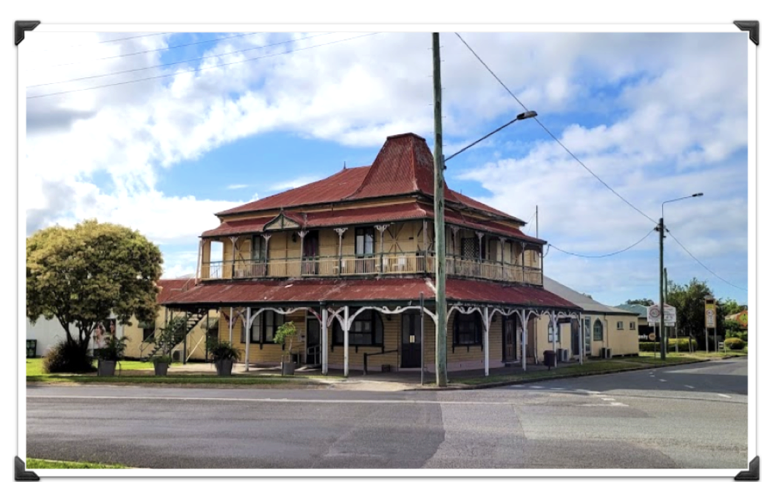
NEW BUILDING. The alterations and additions to Mr. Sloane’s Rising Sun Hotel are now nearly completed and I understand the new premises will be opened. The old hotel, which, for 7 years, was one of Rosewood’s landmarks, was removed bodily to make room for the erection of the new building on the corner of the streets. The new building, which is 38ft. by 38ft. contains, on the ground floor, a bar, 25ft. by 16ft., a billiard-room 29ft. By 21ft. 6in, and entrance hall and staircase, the height of the walls being 11ft. 6in. On the first floor there are four large and two smaller bedrooms. There is an awning over the two footpaths, and above that, a balcony on the first floor, from which a splendid view of the surrounding country can be obtained. The roof is surrounded by a turret, the height of which makes it visible for a great distance. The billiard room is ceiled with Wunderlich’s stamped steel ceiling, and its dimension permit of its talking a full-sized table. The bar fittings consist of large circular counter and shelves with pediment of cedar and pine for displays of liquors. The amount of the contract was £520, and the contractor (Mr. C. Ridsdale) also carried out the plumbing and painting. The joinery was supplied by Mr. A. Foote of Ipswich, and the steel ceiling was supplied by Mr. J. Cuthbert of your city. The architect was Mr. M. Wm. Haenke, also of Ipswich and the building reflects great credit on his skill. The work has been most satisfactorily carried out, and Mr. Sloane is now in possession of one of the most up-to-dated hotels in the district, besides which is also most conveniently situated for the traveling public. [9]
PRESENTATION. On Saturday (5th) evening a gathering was held at Host Sloane’s Rising Sun Hotel for the purpose of making a presentation to Mr. Jas. Rodgers, who has lately joined the ranks of the Benedicts. Mr B. Sloane (the host) occupied the chair, and, in proposing the health of Mr. Rodgers and his bride, voiced the congratulations of their many friends. Mr. Rodgers, the Chairman said, had secured a good helpmate, and he trusted they would live long to enjoy each other’s company. A pleasing duty had been entrusted to him, and that was to ask Mr. Rodgers’s acceptance of a token of goodwill and esteem from his many friends, not for its intrinsic value, but for the kindly feeling which prompted the gift. He then handed Mr Rodgers a dinner service, tea-set, and set of carvers. Mr. A. M’Lean supported the toast, and echoed the sentiments expressed by Mr. Sloane. He also tendered the advice to all the single young men present to follow Mr. Rodgers’s example. Being a bachelor himself, he was well qualified to speak of the many drawbacks to single blessedness. Congratulatory speeches were also made by most of those present. Mr. Rodgers feelingly responded to the many good wishes showered on him and his bride by their friends and thanked them most sincerely for their handsome presents, which he would always look upon with respect and which if he should ever leave the place would serve as a reminder of his kind Rosewood friends. After the presentation, occasion was taken by those present to congratulate Mr. Sloane on the recently completed fine addition to his premises, the new place being opened for business that evening. The toast of “The House” was duly honoured. Mr. Sloane thanked them for the many kind things said of Mrs. Sloane and himself and a very pleasant evening was concluded by the singing of “Auld Lang Syne.” [10]
Photo courtesy of Leanne Cutuli
11th February 1910 – Bernard Sloane was charged with having kept his licensed premises open for the sale of liquor on Christmas Day. Mr Ludwig Zabel had pre-ordered two bottles of rum, but when he got home and took the parcel from his cart it contained wine instead. He sent his son to Rosewood to rectify it on Christmas Day and and Bernard changed it for him, hence the charge. The Police Magistrate decided that under the circumstances he would reserve his decision till a future date. On March 1st the Magistrate decided to view the matter from a common sense standpoint. He ruled that the facts did not show that the hotel was kept open for the sale of liquor during prohibited hours and dismissed the case.
In early April, Bernard’s son Jerry fell on the stairs at the hotel and broke one of his arms near the wrist. He was attended by Dr. P. Allen and spent six weeks healing before he returned to work.
The station master of 22 years, Mr J. K. Burns was farewelled at the hotel. He was promoted to Chief Inspector, Brisbane. Mr Arthur Selwyn Ogg presented him with a beautiful silver afternoon tea set inscribed as follows: “Presented to J. K. Burns, Esq., by the citizens of Rosewood, 22nd August 1911.”
Overseer Percy Harry Adams was engaged forming and blinding the street near the Rising Sun Hotel in August 1913. The metal was obtained from a new quarry opened up on his property near the show ground.
9th April 1914 – B. Sloane, Rising Sun Hotel, renewal of license was granted.
10th October 1915 – George Dale was thrown from his horse at the railway gates and was picked up unconscious. He was carried to the Rising Sun Hotel for medical attention. After a lapse of two hours he regained consciousness and was able to go home.
April 1917 – Mr. E. S. Inness, accountant of the Bank of Queensland in Rosewood, has been transferred to Brisbane. Before leaving Rosewood he was entertained by the proprietors and boarders of the Rising Sun Hotel, who presented to him a handsomely-finished suit case. In making the presentation Mr. J. P. Walsh referred to the good work Mr. Inness had done for the district, and said their guest was a very courteous and obliging bank officer, as well as an excellent committee man on many of the local institutions. Messrs. Bulcock, Sloane, Hahm, and Sheppard, also eulogised the services of Mr. Inness. [11]
In May 1918, Bernard and Catherine Sloane, of the Rising Sun Hotel were advised that their son Jerry, who had been with the troops in Egypt for some time, had been wounded.
Jeremiah Bernard Sloane died on 7th October 1919 aged 56 years. Bernard had been a member of the State SchooI Committee for many years and a member of various other bodies. For several years he was a member of the Rosewood Shire Council, having first been elected on the occasion of the amalgamation of the old Mutdapilly and Rosewood Divisional Board areas. In February 1916 he was elected Chairman of the Rosewood Council by the unanimous vote of his colleagues. He was also interested in the farming industry. His widow (Catherine nee Farrell) became the licensee of the Rising Sun.
6th April 1920 – Catherine Sloane was granted the license for the Rising Sun Hotel, Rosewood.
Jeremiah Bernard and Catherine had 6 children, William Edward, Margaret, Jeremiah Bernard jnr., John Michael, Patrick James and Mary Ellen. Margaret, born 1891, was known as “Cissy.” She had worked in the hotel since she was old enough and was a popular personality. After her father’s death, her role in the running of the hotel became more significant.
Mr. William Naylor, of Ipswich, took over the hair-dressing saloon at the Rising Sun on 10th July 1922 for a few years.
In September 1924, Miss Molly Thomas was the guest of honour at a pre-nuptial evening (before her marriage to Gerald Nolan) arranged by Mrs. Sloane at the Rising Sun Hotel. There was a large number of guests, and a happy evening was spent with jazzing, musical items and competitions being enjoyed. The bridal and Wedding Marches were played by Miss Cissy Sloane, with violin obligato by Miss Eileen Farrell. During the signing of the register, Pat Sloane sang “Ave Maria.”
After spending their honeymoon in Sydney, Jeremiah Bernard Sloane jnr., aka “Jerry” and his new wife Helen née Lindsay were given a “right royal welcome” at the Rising Sun on their return home.
In July 1929 – Mr. J. Sillman, of Rosewood (National Bank), who left during the weekend for Innisfail, was entertained at the Rising Sun Hotel by a number of his friends on Friday night. Mr. W. Kerr, on behalf of the party, presented him with a case of pipes as a souvenir of their pleasant associations. [12]
During the Depression years Cissy operated a soup kitchen on the back verandah of the hotel.
Rosewood Diggers’ Reunion – May 7.
About 60 persons were present at a reunion of Rosewood Diggers and friends at the Rising Sun Hotel. The loyal toast was followed by a minute’s silence in respect to the memory of absent comrades. Mr. J. B. Sloane, president of the Rosewood sub-branch presided, and during the evening presented to Mr. Wren (State Staff) a cheque for £15 15s., being a second donation to Montrose Home (a home for ex-servicemen). A previous donation of £5 5s. had already been sent, making the total double the quota agreed upon. It was announced that the Rosewood branch would endow and maintain a cubicle at the home. Mr. Lloyd (State Secretary) was amongst the visitors. [13]
Catherine Sloane (pictured at left) died on 15th April 1942 at her home, the Rising Sun Hotel. Throughout her life, she was exemplary in the practice of the Catholic faith. Her daughter Cissy (Margaret) took the reins.
Read Catherine’s Obituary
Rev. Father Patrick Joseph O’Rourke, Parish Priest of Rosewood, attained the silver jubilee of his priesthood on Wednesday 15th July 1942. He was ordained in County Sligo for his Australian mission. The occasion was marked by a High Mass in St. Brigid’s Church that morning. A large number of visiting priests attended the Mass and Very Rev. Monsignor Fitzgerald, Brisbane, delivered the occasional address. A concert and presentation from the Convent School children took place later. Father O’Rourke and the visiting clergy were entertained by the Celebration Committee at a jubilee dinner at Sloane’s Rising Sun Hotel where an attractive jubilee cake adorned the table.
Local dentist Walter Grealy was the recipient of many wishes for good luck and happiness when a group of his friends met at the Rising Sun Hotel on 1st April 1947, one week before he married Miss Rita Doherty (Margaret Mary Rita). Those present were Father O’Rourke, Messrs. M. Quirk, A. McArthur, D. Fox, and J. Mackie. Walter was also guest of honour at a card party at Mr Arthur Sellars’ home a few days before.
On 29th August 1947 – The Rosewood and District Amateur Fishing Club finished its winter season with a trip to Short Island. Thirty-four members made the trip, and everyone had a good catch. F. Dale. M. Donaldson, and L. Akes tied for the heaviest fish, a sealed club trophy was won by F. Dale, M. Donaldson, and L. Akes, and the Rising Sun Hotel trophy (sealed competition) was won by R. Brooks. During the winter season 1425 fish were caught by an average of 16 members. It was decided to open the summer season with a trip to Jumpin Pin on September 7. Members will fish for two club trophies and a trophy donated by Mr. Dave Robinson for the heaviest fish caught on the trip. [15]
On 25th November 1947 – A pleasant function was held In the lounge room of the Rising Sun Hotel, when members of the Northern Suburbs Cricket Club honoured their captain (Mr. Bob Sellars) on the eve of his marriage. The President of the Club (Mr. G. Houston) said that the popularity of their guest was reflected by the large gathering. Mr. Houston’s remarks were supported by Messrs. J. Davis, W. Grealy, W. Smith and A. Sellars. The club Secretary (Mr. A. McArthur) handed Mr. Sellars a silky-oak smoker’s stand. Mr. Sellars responded. Refreshments were served and toasts were honoured, including a toast to the newly married Royal couple. [16]
Margaret Sloane “Cissy” is listed on the electoral roll in 1958. She was living in School Street and was a Licensed Victualler. She died aged 70 years in 1962 in Brisbane and is buried in Nudgee Cemetery.
With more research in the future, I’m hoping to find out what happened from here.
The electoral rolls shows that:-
1959-1963 William Clive Geldart was a Hotelkeeper Residence: School Street, Rosewood. Wife: Daphne Irene Geldart, Home Duties.
I did read that John Michael “Jack” and Irene McKerrow owned the Rising Sun from 1964 -1967.
Back to the electoral rolls:
1968-1980+ Rex Allan and Valerie Dorothea (died 1972) Haley were Hotelkeepers. Residence: School Street, Rosewood.
A brutal and terrible event occurred in a room at the hotel on 6th January 2008. Two men beat, kicked, stomped on and strangled a chef to death. Raymond John Bound, 61, of Ipswich, and Lochlan-Lee Brett Belford, 21, of Rosewood, were found guilty of murdering 28 year old Wayne Williams because he was gay. They were jailed for life for his murder, then appealed their convictions and lost
On the 5th May 2013, the “Cissy Sloane Crossing” (near the hotel) was unveiled in memory of the three generations of the Sloane family who lived and worked at the Rising Sun Hotel.
Some of the people who lived at the hotel were:
Ellen McGuire, Domestic Duties 1911
Olive Leah Sharpe, Domestic Duties 1911
Emil Julius Moller, Artist 1911
Mary Catherine Finnigan, Servant 1917
George Ernest Morgan, Hairdresser, and wife Dorothy Gertrude Morgan 1921
Joseph James Overell, Draper 1921-1922
Royal de Stokar, Chemist 1926
Ethel Mary Laurison, School Teacher 1931-1932
Allen Wallace Slater, School Teacher 1939
Samuel Hunter, Priest 1949
A folk lore story which is told in the wider community about men in the early days sitting in the turret of the hotel and watching for the Cobb and Co coaches to arrive, is not true, as can be seen by the following:-
1. Cobb & Co’s coaches did not come to Rosewood. Their route was from Brisbane to Ipswich where passengers and mail were transferred to trains which ran directly to Grandchester. The passengers then boarded another Cobb & Co coach for the journey to Toowoomba.
See “Cobb & Co and Rosewood” .
2. William Pitt Vance indicated in his recollections, that there were established coach routes before the railway went through, where mail and passengers were carried from Brisbane to Ipswich and on to Toowoomba by various different operators. Other coaches (not Cobb & Co), mail carts, wagons and loaded drays would have stopped at both of the Rising Sun Hotels.
3. William Haenke, Architect, drew the plans for the hotel with the turret and spire in 1908, long after Cobb & Co had stopped running to Toowoomba.
In October 2023, work began on the exterior renovation of the Rising Sun Hotel. It received a new roof, new railings, new exterior lighting, small spires, new paintwork and a small ornamental turret was reinstated to reflect its original appearance. (Originally there was also a spire on top of the turret roof.) If there ever was a way out to the roof, no trace of any method by which a person could access the ornamental turret was found in the roof cavity during the renovation, according to local resident Arthur Wass, who questioned the contractors.
As for the first old hotel, I’ve been unable to find any reference to, or a record of there being a turret on that building.
UPDATE – 7th November 2025
Recently I was thrilled to be given the opportunity to have a conversation with Father Henry Joseph Moore, known as Harry Moore. Harry is a retired Marist Priest and is a descendant of Bernard and Margaret Sloane via their son (Jeremiah) Bernard and Catherine Sloane née Farrell. Harry’s parents married in St Brigid’s Catholic Church in 1929. Fr. Harry shared some of his recollections of the old Rising Sun Hotel, a place he was very familiar with as a boy.
Harry spoke of a different time. It was very gentile in those days. Linen tablecloths adorned the tables with solid silver cutlery. In the 1940’s there were remnants of the silver cutlery but the tables were set with silver plated cutlery and linen serviettes, folded in the shape of crowns. If you were a regular diner your serviette was held by a silver plated serviette ring. You didn’t always have a new serviette, but retained the serviette and ring it until it became prudent to change it. Cissy wrote the menu in her copybook handwriting.
He recalled one of his jobs was helping to polish the silver cutlery etc.. Another was polishing the brass. There was a carpet runner on the stairway to the second floor, which was held in place with brass rods and screw-in finials. Harry remembers polishing them many a time.
Under the stairs where the fire hose hangs today there used to be a phone. The number was Rosewood 13. Where the men’s rest room is there was a small room with a double bed, where Harry Moore and his older brother Peter slept.
Harry then told me something of great interest. Immediately at the top of the stairs was a small room where there was a manhole. As a child he used to climb through the manhole, and if he stood up on a small ladder, there was trap door where you could look out. However, he said you could not climb out and up to the turret as it was purely for cosmetic purposes. His older brother and cousin used to stand in the opening and smoke.
There was a large tree outside the front of the hotel, and there were two cottages beside the hotel where the carpark is now. Tony Zande (Morte Antonio Osvaldo Zandeciacimo), a coal miner, lived in one of them.
Harry sent me a photo of his painting which depicts how he remembers the hotel, and he allowed me to post it for you all to see.
Harry’s grandmother, Catherine Sloane, had farmland outside of town on Reilly’s Road. (Her father, John Farrell, was the original selector of this land. Portion 6 – 96 acres). Catherine used to let a man named Grieve Dove, a veteran drover, live there. A friend of Grieve’s, an aboriginal man named Jimmy, also lived there. Catherine used to feed Grieve and Jimmy for free in a room at the back of the kitchen, which is where she provided many meals for those in need. One day Harry’s sister, Pauline, asked Jimmy why he always walked around the outside of the hotel? Jimmy told her it was because he was not allowed to go inside through the hall. Pauline still remembers the day that Jimmy bought her an ice cream with his own money.
Harry said that the present day dining room was part of the pre 1909 hotel. The other older section next to the hotel with the casement windows, was the old dining room.
Well known local man, Teddy Thomas, told him that his grandfather, Barney Sloane, had a beautiful singing voice, and he used to sit outside of the hotel and sing.
During a recent visit to the Rising Sun Hotel with his niece Leanne Cutuli, Harry drew a plan of the hotel as he remembered it in his youth. He also gave me permission to share this with you, so Leanne sent it on to me so I could do so.
Thank you so much Father Moore for your memories, the painting and the plan.


Some more photos courtesy of Spencer Yarrow. The one on the left is pre 1972.
Images of the Rising Sun Hotel during renovations.
8th October 2023 – 3rd January 2024
Photos: Jane Schy
It’s wonderful to see such an iconic building looking so grand once again!
Youtube – Rising Sun Hotel, Rosewood, Australia 2023
References:
[1] The North Australian, Ipswich and General Advertiser, Tuesday 31st August 1858, page 3
[2] The Moreton Bay Courier, Tuesday, 15th January 1861, page 6
[3] Queensland Times, Ipswich Herald and General Advertiser, Saturday 14 July 1877, page 3
[4] Telegraph, Saturday, 23 November 1878, page 2
[5] Brisbane Courier, Thursday, 28 November 1878, page 2
[6] Queensland Times, Ipswich Herald and General Advertiser, Saturday, 17th January 1880, page 4
[7] Queensland Times, Ipswich Herald and General Advertiser, Thursday, 29th October 1891 page 2
[8] Queensland Times, Ipswich Herald and General Advertiser, Thursday 18 February 1904, page 3
[9] Queensland Times, Ipswich,Saturday, 5th June1909, page 2
[10] Queensland Times, Ipswich, Thursday, 10th June 1909, page 4
[11] Brisbane Courier, Monday 30 April 1917, page 11
[12] Queensland Times, Ipswich, Wednesday 10th July 1929, page 10
[13] The Telegraph, Friday, 13th May 1938, page 11
[14] Queensland Times, Ipswich Herald and General Advertiser, Tuesday 20 February 1894, page 4
[15] Queensland Times, Ipswich, Saturday 30 August 1947, page 3
[16] Queensland Times, Ipswich, Tuesday 25 November 1947, page 6
6 Comments
Wow, there has been a lot of research into the history of the Rising Sun! Well done Jane, look forward to more of Rosewood’s history!! Congratulations on your website!
Thank you Sandy. Much appreciated!
The photos of the hotel have the extension to the right these were not in the original hotel and only added in recent times.
Thank you for adding that information Greg. I have added a caption to the black and white photo which shows the hotel without any extension.
Really enjoyed reading this article Jane. Meticulously researched as usual. Thank you!
The so called extensions are the original single storied hotel which was dragged by bullock dray to its location on the corner and then moved back to allow the new two story hotel extension to be built in 1908.