
Rosewood History
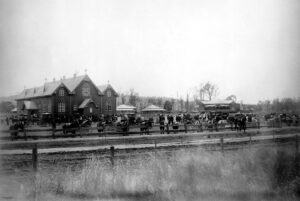
The new St Brigid’s Catholic Church, Rosewood, February 1910 – S. A. Best Pty Ltd., Photographer
CHURCHES
Congregational Church (1875) Uniting Church (1977)
21 John St, Rosewood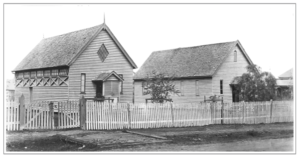
At the end of 1874 a meeting of the faithful was held at the home of Samuel Waight and after a few months it was agreed to establish a church in Rosewood. The church was opened on 24th May 1875 in John Street on an acre of land donated by William Mathew at a cost of £125. The distinctive bell tower we see today was added in 1925, donated by Mrs Elizabeth Evers in memory of her husband.
A new church was erected on the site in 1953 and opened in 1954. The original buildings were sold for removal and became the Masonic Hall in William Street. The church hall was built in 1963. In 1977 the church become part of the Uniting Church in Australia.
Rev D. Mossop 1875; Rev. Mark Dixon 1881; Rev. Thomas Ernest Pierce 1883; Rev. William Brown 1884-1886; Rev. Charles Travis Roper 1888; Rev. Hugh Gibson 1891; Rev. Henry Rawlings 1892-1897; Rev. Ralph Figgis 1898- 1902 ; Rev. Albert Edward West 1902-1907; Rev. Arthur Castlemaine 1908-1912; Rev. Alexander McKinlay 1913-1916; Rev. Cummings Air Capern 1916-1922; Rev. Nelson Howard Finch 1923-1925; Rev. Joseph William Harper 1925- 1931; Rev H. Whyte M.A 1931; Rev. Herbert Joseph Taudevin 1932-1935; Rev. Norman Campbell Watt 1936-1940; Rev. Caleb Beharell 1940-1945; Rev. Thomas Critchell Arnold 1945-1948; Rev. Joseph Dyer 1948-1951; Rev. Herbert Joseph Taudevin 1952-954; Rev. Thomas Clifford Lloyd Anthony 1955-1957; Rev. Graham Dudley Hall 1958-1965; Rev. Brian Smith 1965-1970; Rev. Thomas William Pinkney 1973-1975; Pastor Rob Duncan; Rev. Peter Taubner; Rev. Peter Woodford (supply); Rev. Leva Pat (supply); Rev. Marian Zaunbracher (supply); Rev. Peter Bale; Rev. Brian Kickbisch; Re. Darren King (supply); Rev.Trevor Foote (supply); Rev. Alister Cameron; Rev. Ron French; Rev. Robert Walker; Rev. Dr. Tony Torvell (supply); Pastor Nancy Bunschoten (supply); Pastor David Wiltshire; Rev. Ron Wallace; Pastor Keith Vincent; Rev.Tom Pinkey
Rosewood Congregational Church – First 100 Years (Part 1)
Rosewood Congregational Church – First 100 Years (Part 2)
Rosewood Congregational Church – First 100 Years (Part 3)
Rosewood Congregational Church – Weddings & Funerals
Wesleyan (Methodist) Church Tallegalla (1880)
363 Rosewood Marburg Road, Tallegalla
 A new Wesleyan chapel was opened by the Rev. Robson, the circuit minister, on the 17th May 1880 at Tallegalla. The church cost £50 and was opened free of debt because of the efforts of the residents of the district. In 1908 it was replaced by a new building constructed by Charles Ridsdale. The new Tallegalla Methodist Church was opened on the 3rd May by Rev. A. G. Smith. A church hall was added and dedicated by Rev. F. J. Harris on 10th September 1948. The hall was used as the Sunday School and as a meeting place for recreational activities.
The hall was rotated 90 degrees and converted to the shop-front in the late 1980s by Dennis Herrick. Dennis and his young family lived there into the 1990’s before moving away from the district. It is now being used by the Rosewood Men’s Shed.
Primitive Methodist Church (1882)
72 John Street, Rosewood
The first church was built in April, 1882 by the Corporation of the Primitive Methodist Church Connextion on half an acre of land (2 roods) facing John Street (Lot 22, now the site of Rosewood Library). It was donated by John William Vance. The church building was moved further up John Street to the corner of Church Lane & John Street (Lot 68). The Primitive Methodist Church acquired this land (23 3/10 perches) on 30th April 1886. In 1893 the building, which the Anglicans had been using, was purchased by the Church of England (St Luke’s).
3rd December 1884 – On Wednesday evening, the residents of Rosewood were entertained in the Agricultural Hall for an hour and a half, by the rendering of a service of song entitled “Eva.’ Mr Mark Bensley, J.P., an old and much respected resident of the district, and a man ever willing to assist in anything which has for its object the welfare of the neighbourbood in which he resides, was welcomed to the chair by hearty rounds of applause. The connective readings were given by the Rev. W. Little, of Ipswich, and were listened to by the audience with deep attention. Mr F. W. Johns presided at the harmonium in his usual masterly style, and led the singing in a highly creditable manner. The members of the choir consisted of the Misses Vance, Miss Holt, Miss Waight, Miss Hudson, Miss Phillips, the Misses Jacobs, the Rev T. Nock, and Mr W. H. Lillingstone. The audience, which was a large one, seemed quite satisfied with the entertainment, and the usual vote of thanks to the choir, the president, and the Rev. Mr. Little terminated the proceedings. The financial proceeds, amounting to about £3, are for the reduction of the debt on the harmoniumn recently purchased by the Primitive Methodists of Rosewood Gate.
St. Brigid’s Catholic Church (1885 rebuilt 1910)
81 Matthew St, Rosewood
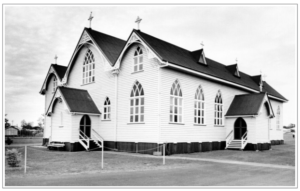 Rosewood settlers attended Mass at Ipswich, sometimes making the journey on foot. The first Mass in Rosewood, conducted by by Rev. Pere Brunn, was held in the home of Mr. and Mrs. Moran in 1872 . Rev. Father Horan celebrated Mass at the home of Mr. James Ryan of the Rising Sun Hotel around 1874. This venue continued to be used throughout the years as it passed into the Sloane family’s hands in 1881 and on until the opening of the first church in 1885. The church was opened by Archbishop Dunne. The church was built by R. J. Murphy and was constructed of hardwood with a shingled roof, and dedicated as “St. Brigid’s”. It is situated in Railway Street.
In 1910 the present church, “the finest wooden church in the diocese”, was opened by His Grace Archbishop Duhig. It was built from the fine timbers found in the Scrub. The old church was used as a parish hall for some time and in 1916 a presbytery was built. The Sisters of Mercy came to the parish in 1922 and the presbytery was converted into a convent.
This magnificent church is said to be the largest wooden church in Australia, and arguably, the most beautiful. The church houses a rare ecclesiastical mural painted by William Bustard.
Rev. Father Timothy Kelleher 1915-1920; Father McKenna 1920 -1927; Rev P. J. O’Rourke 1927 – 1947; Father M. J. O’Connell.
St Brigid’s Church was listed on the Queensland Heritage Register on 21st October 1992. Although the church building had been slowly leaning for many years, it was deemed unsafe in 2020. A project to straighten and restore the church is underway.
New Church at Rosewood (1910) More information on Wikipedia
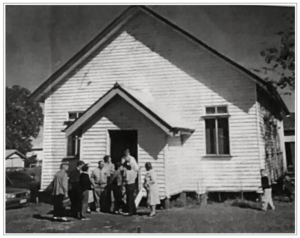
Church of Christ (1885)
34 Albert Street, Rosewood
In 1883, a Church of Christ was formed in the home of Mr and Mrs Colvin. In January, 1883 the first organised Church service was held in the home of Mr and Mrs T. F. Stubbin, about three miles from Rosewood. In 1884, services were held in the Farmer’s Hall then in February, 1885 they erected a church building on the corner of Matthew Street and Walloon Road. It was moved the same year to Albert Street. In 1922 the old building was sold and a new chapel was erected. On Saturday 27 January 1923, the new Church of Christ chapel was officially opened at 34 Albert Street.
The final service was held in the church on Sunday, 27th May 2001.
Bro. Troy. 1883; Edward Bagley 1885; A. Mordaunt; James Park; Evangelist H. Bassard 1922-1926; W. J. Campbell 1926; Rev C. E. Saull 1937.
Queensland Times, Thursday 16 November 1922, page 7
Church of Christ In Rosewood, a new and larger church is shortly to be erected. The work of removing the present building to Mr. W. Domrow’s allotment, a block lower down, was commenced on Monday by voluntary workers. Meetings will be carried on in the present building until the new church is erected. The new building will be erected on the same site as the old one. The present building, was removed bodily to Mr. Domrow’s allotment today by a team of horses. The process attracted considerable attention.
Queensland Times , Wednesday 31 January 1923, page 10
Opening of Church of Christ Chapel.- Saturday last was an important day in the history of the Church of Christ at Rosewood, when the official opening of the new chapel in Albert Street took place. The old building was recently removed bodily to Mr. W. Domrow’s allotment, to be converted into a dwelling. The fine large structure, which now stands on the same site as the old chapel, testifies to the progress of the church of Rosewood, and the zeal of its members. The building stands on high blocks, and the furnishing throughout and lighting system were carried out on up-to-date lines. The church, in the erection of which members of the church gave voluntary labour, is an added adornment to the town.
The opening service took place in the church on Saturday afternoon, when a good number was present. The proceedings were opened by the singing of the hymn, “All Hail the Power,” and prayer led by Bro. F. Primus (president West Moreton Churches of Christ). Evangelist Bassard expressed pleasure at having representatives of the church present from Toowoomba and Brisbane. On behalf of the Church of Christ he extended a loving and hearty welcome to all present at the meeting. Bro. Vanham of Toowoomba, congratulated the Rosewood members on their magnificent achievement in the erection of their new building, which showed the progress of the church, and that it possessed the right type of members, who were zealous in its interests. Bro. Primus delivered a reading, and the hymn “Oh God Our Help” was sung. Bro. Primus expressed pleasure at being present at the opening of the chapel, which was erected for the honour and glory of God. He had been a member of the church for the past 33 years, and in the course of his address referred to the hard struggle experienced in the past. He made reference to the splendid Christian work done in the district by their former pastor, Evangelist Rodger. He congratulated Evangelist Bassard, the Brothers and Sisters, on their noble effort.
The secretary (Bro. W. Domrow) then submitted the balance sheet, showing the financial position to be very satisfactory. Greetings were received from Stanthorpe and from Bro. Arnold (Boonah). Rev. C. A. Capern extended cordial greetings from the Congregational Church, and congratulated the members of the Church of Christ on their splendid building, which showed the great strides they have made. Bro. Adermann, Brisbane, of the Home Mission, extended congratulations on the fine building for the work of God, and referred to the energy of their Evangelist. Their church, erected in a newer and bigger form, testified to the fact that spirit and enthusiasm still existed in the universe, as evidenced in this locality. Bro. C. Fisher (Russell Island), an old pioneer of the church, related reminiscences of his association with the work in this district in the past, and expressed pleasure at being there that day. Evangelist Bassard referred to the voluntary work given by the members in the erection of the building, which had considerably broken down the expenses. He thanked those who had given such valuable assistance, particularly Bro. W. Dowrow, who showed great enthusiasm in the work. He asked them not to let their enthusiasm die, but to go ahead, with the motto “Souls for Christ.”
The afternoon’s proceedings closed with the Doxology. At 6 p.m. a large number sat down to tea, which was served on tables arranged under the church building. The catering was capably attended to by the ladies. At night the celebration was carried out on an extensive scale.
Early in the evening visitors from the surrounding districts, including Mount Walker., Rosevale, and Marburg continued to arrive in large numbers by motor lorry, cars, and other vehicles, and visitors from Brisbane, Ipswich, and Boonah were also present. Before the commencement of the meeting, every available seat in the building was occupied. Evangelist Bassard presided, and the proceedings opened with the singing of hymns. An appeal for funds to reduce the debt remaining on the chapel was then made by Evangelist Bassard. He stated that the building had cost between £600 and £700, and after deducting the amount already collected, a debt of £328/7/8 remained. In response to the appeal the sum of £91/15/ was received in a very short time. A prayer of thanks giving was then offered, led by Bro. Adermann. The Rosewood Choir rendered a musical item, after which the treasurer’s report was given Evangelist Bassard announced th:la the debt now remaining was £236 12/8. He thanked all who had rendered such valuable service by the voluntary help, and to all who worked and gave towards the church.
Addresses were given by Bro. J. Coward (Brisbane), Sister Wendorf (president of the Queensland Sisters Conference), Bro. Wendorf (Brisbane), Bro. Berlin, sen. (Brisbane), and Bro. A. Henriehsen (vice-president West Moreton Churches of Christ). Musical items were contributed by Miss M. Jensen, Messrs, A. and J. Jensen, Miss L. Henrichsen, Miss Murry, Bro. Bassard, Bro. Morris, Rosewood Choir, and a dialogue waa rendered by a number of friends from Marburg. The singing of the hymn “Till We Meet Again” and Doxology concluded the proceedings. Miss Dorothy Bade presided at the organ throughout the proceedings. The dedication of the chapel took place at the 11 a.m. service on Sunday, and in the evening a service of song and prayer meeting was held. The attendance at the services was large.
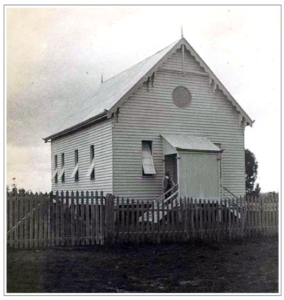
Baptist Church (Lanefield) (1887)
Stevens Rd near the corner of Henderson Rd, Lanefield
A hardwood building 36 ft x 26 ft with 15 ft walls, and lined throughout for the Rosewood Baptist Church was completed by Alfred Colthup and David Hopper and opened 8th April, 1887. The Architect was R. Gailey from Brisbane. The church was situated at Stevens Road near the corner of Henderson Road. The work of the church was moved to Rosewood in 1959 and the church was sold for demolition. Mr Collier bought the building and used the timber to build his house near the old Tallegalla railway station.
Rev. N. C. Watt 1887; Thomas Vigis Oct.,1887-1888; W. Petie 1888; Edwin Robert Makin 1890-1892; Thomas Uren Symonds 1892-1897; Rev. G. H. Leigton 1898-1899; Rev. J. Glover 1900-1902; Ezekiel Barnett 1902; Thomas E. Ashworth 1916; Rev A. J. Chisholm 1937
Rosewood Baptist Church (1959)
84 John St, Rosewood 4340
The work of the Lanefield church was moved into into Rosewood on 25th January 1959 and a new church hall was built. This was during the ministry of the Rev D. A. Dunlop (November 1957 and July 1963). Two blocks of land in John Street, Rosewood, were purchased for the sum £800, and plans were drawn for a new church building. The Lanefield church building was sold for two hundred and fifty pounds to Mr Bob Coller, who used the timber in building his residence at Tallegalla, near the old Tallegalla railway station. The estimated cost for the new church building in Rosewood was 4,944 pounds 10 shillings. Many people worked willingly, cutting and carting timber, and helping with the building work. A “stump-capping” ceremony was held and finally the new church was officially opened by Mr R. J. Morris, President of the Baptist Union of Queensland, on 5 August 1961.
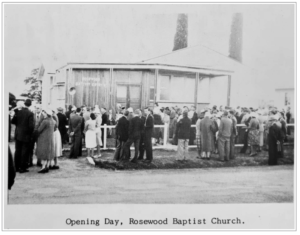
Salvation Army, Rosewood (1887)
Sergeant Perrem 1893; Brigadier Brutnell 1901; Adjutant Rudd 1908; Adjutant V. Ford 1930
A branch of the Salvation Army was started in Rosewood in 1887 in the Farmer’s Hall where they continued to gather thereafter.
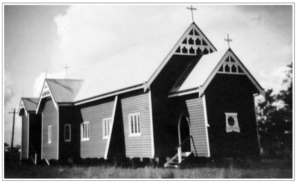 St. Luke’s Church of England (1893)
72 John St, Rosewood 4340
In 1893, the Anglican community bought the disused building formerly occupied by the Primitive Methodist Church and enlarged it. For three years prior to that services were held in Mr and Mrs P. Adams’ home and the assemblies were visited by clergy from Ipswich. Rev. W. S. Heathcote was the first minister.
A new church (double the size of the old one) was built in 1930 to accomodate the large congregation and it was dedicated on 5th April by Archbishop Dr. Sharp of Brisbane, under the name of St Luke. (Cost £1,000)
Rev. W. S. Heathcote 1890; Rev. H. Gradwell; Rev. W. S. Heathcote 1906-1908; Rev. A. E. Attkins 1909-1911; Rev. J. R. Needham 1911; Rev. H. E. Trask 1912; Rev. T. Wilson-Hely 1912-1916; Rev. George Neale 1917-1921; Rev. T. Edwards 1922-1923; Rev. T. H. Clark 1924-1925; Rev. A. W. Gilbert 1926
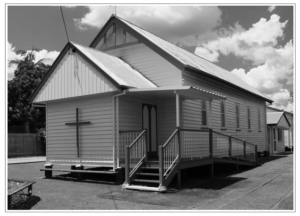
St Matthews Lutheran Church (1930)
63 Matthew Street, Rosewood
A new church building measuring 32 x 20 feet was erected in May/June 1930 on an allotment in Matthew Street. The contractor was J. Bowles.
1928-1929 Pastor C. M.L. Doehler; 1929-1959 Pastor C. A.G. Doehler; 1948-1949 Pastor W. B Uebergang; -1949 Pastor H F Quast; 1950-1955 Pastor A. E Schirmer; 1959-1966 Pastor V. S Grieger; 1960-1966 Pastor R W. Gerhardy; 1967-1973 Pastor A. H Koehler; 1971-1978 Pastor Gerald D Dahlenburg; 1978-1984 Pastor G. H. Maas; 1993-1998 Pastor M J. Uebergang.
Queensland Times Friday 23 May 1930, page 12
ROSEWOOD Tuesday. Lutheran Church – A new church building, measuring 32 x 20, for the adherents of the Lutheran Church, is in the course of erection at Rosewood. Eighteen months ago, fortnightly services of the Lutheran Church were commenced at a private residence in Rosewood. Since that time the membership has increased (now numbering 20) and its zealous members, having decided to procure their own church property purchased an allotment of land in Matthew-street. On this their church is being built, the work of which it is hoped to have completed in about six weeks’ time, when the opening ceremony will take place. Pastor Dohler of Ipswich, has charge of the Rosewood Church, and Mr. W. Schlefelbein is Secretary of the organisation. The contractor of the new church is Mr. J. Bowles.
Wesleyan (Methodist) Church (Ebenezer) (1871)
353 Ebenezer Road, Ebenezer 4340
Queensland Times, Ipswich Herald and General Advertiser, Saturday 27 May 1871, page 2
On Sunday, April 23rd, the opening services in connection with the new Wesleyan Church at Seven-mile creek, was preached by the Rev. W. G. R. Stephinson, of Ipswich. The opening tea-meeting in connection with the same church was held on the evening of the 24th instant, when a report was submitted by Mr. Whitney, and addresses were delivered by the Rev. Messrs. Stephinson and Midgley, and Messrs. Wilbox, Allen, Woolley, and Whitney, sen. The chapel, which is a very neat building, is to be called Ebenezer; it is well attended and supported by the persons living in that locality, who feel that the prospects of Wesleyan Methodism are of a most encouraging and satisfactory character.
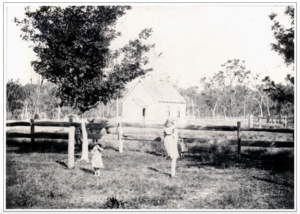
Antcliffe family in front of the Methodist Church, Ebenezer, near Ipswich, c.1905
(Photo-Picture Ipswich)
The trustees had disposed of the Ebenezer Church by June 1945.
Bethlehem German Lutheran Church (Stone Quarry, Seven Mile Creek) (1873)
Queensland Times, Ipswich Herald and General Advertiser (Qld. : 1861 – 1908), Thursday 29 May 1873, page 3
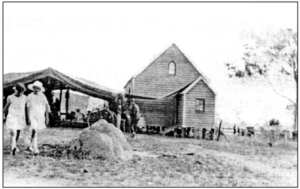 The church was consecrated at noon on Monday 19th May by the Rev. E. Heiner, of Ipswich, assisted by the Rev. C. Hellmuth, of Logan River. At the appointed hour about 200 persons from various localities, including a few visitors from Ipswich, were assembled at the premises of Mr. George Kelly, at which place a procession was formed, which proceeded to the new church. The ceremony began with the singing of the hymn” Unn danket all und bringet Ehr,” after which the Rev. E. Heiner, in the name of the congregation, thanked the landlord, Mr. G. Kelly, for having so kindly lent his premises for the purpose of holding Divine service in for the last four years. The Rev. gentleman having engaged in prayer, the assemblage moved in procession to the new building, singing the hymn “Zeuch ein zu deinen Thoren.”
On his arrival at the church, the Rev. E. Heiner addressed the congregation, choosing his text from Psalm cxxii., 1-9. Mr. John Guth, trustee of the church, then handed the key to the rev. gentleman, who opened and consecrated the building in the name of the Holy Trinity, adding the 3rd verse of the cxxi. Psalm. The people then entered the church, led by the Revs. E. Heiner and C. Hellmuth. Another hymn having been sung, the Rev. C. Hellmuth preached the ” chief sermon,” taking his text from the fourth chapter of 1st Peter, 8th to 11th verses, which made a great impression on the congregation. At its conclusion the Rev. gentleman e-gaged in prayer, after which a collection was made, amounting to £8 12s. 8d. The people then adjourned to the premises of Mr. G. Kelly, where they refreshed themselves on the good things that were provided for all comers.
In the evening addresses were delivered by the two Rev. gentlemen respectively; and the whole ceremony concluded with the singing of the hymn “Unn danket alle God;” and the benediction was pronounced by the Rev. Mr. Heiner. The total proceeds, including collections, were about 11, which sum together with the subscriptions leaves the Church in debt to the trifling extent of £5 , which it is hoped will be wiped off at an early date. The size of the building is 26ft. by 16ft.; it is composed of sawn hardwood timber, and was erected by Mr. Charles Hertzberg. Much credit is due to Mr. Gustav Weise for the energy displayed by him in collecting subscriptions and in forwarding the interests of the church generally.
Queensland Times, Ipswich Herald and General Advertiser (Qld. : 1861 – 1908), Thursday 28 April 1898, page 2
THE NEW LUTHERAN CHURCH AT STONE QUARRY. (FROM A CORRESPONDENT.) On Wednesday, the 20th instant, some 300 or 400 persons attended at the opening of the New Lutheran Church at the Stone Quarry, near Ebenezer, visitors from all parts of West Moreton, as well as from places further afield, being in attendance. Among those from Ipswich I noticed Messrs. J. Schoenle and family, Mr. G. R. Weise, Mrs. Kruger and children, Mr. and Mrs Wilce, Mrs. Kennedy and children, and others.
The church is a neat little structure, 26ft. x 16ft., and it has been opened clear of debt. The cost of the building was £50, which sum was largely raised by a collecting committee, consisting of Messrs J. H. Schoenfeldt, W. Runge, J. Werner, C. Runge, sen., and E. Kroll. The contractors were Messrs. Hoffmann and Helmich, who have performed their work in a very creditable manner. A fine cross surmounts the front gable, and is the gift of the contractors. A committee, consisting of Messrs. J. Schoenfeldt and C. and W. Runge, supervised the work.
Two repasts were provided, the first at 1 o’clock and the other at 4, and the charge of one shilling admitted the payer to both. The quality and quantity of the viands made one wonder how they could be supplied for the money. Most obliging and attentive waitresses were found in the persons of Mrs. and Misses Schoenfeldt (two), Mrs. and Miss Hoffmann, Mrs. S. Hoffmann, Mrs. Helmich, Mrs. Hertwick, Mrs. Muller, Mrs. Rahn, and Mrs. Runge, besides whom there were a number of other willing helpers.
The interior of the building had been most profusely decorated for the occasion, and the tasteful intermingling of flowers and ferns and greenery, with a judicious intermixture of designs worked in coloured paper by Mr. C. A. Kruger, of Mutdapilly, produced a very pleasant effect.
After the first meal had been partaken of, the ceremony of dedicating the church was entered upon. Pastor Becker, F.B.U., of South Brisbane, opened the proceedings by repeating the dedication-“In the name of the Father, and of the Son, and of the Holy Ghost. Amen.” Then the congregation joined in singing the hymn “Praise ye the Lord, the Almighty, the King of Salvation.” Pastor Sülkmann, of Waterford (President of the United German and Scandinavian Synod of Queensland), handed the key of the new church to Pastor Becker (who is in charge of the. parish), naming the church as he did so “The German Lutheran Bethlehem Church of Stone Quarry.” Pastor Sülkmann conducted the consecration ceremony, assisted by the synodical clergy. He based his remarks on Psalm cxix., 90 and 97. In the course of his address, he stated that the old church was not a very nice structure, and that the new one was a great improvement on it, and far more beautiful than he expected it would be. He hoped that the congregation would attend regularly and in large numbers to hear God’s pure true word, than which God forbid that anything else should be preached in that House of God. He then exhorted the assemblage not only to attend the services, but also to talk to each other afterwards about what they had heard, and to act on the teaching of the Word.
Liturgy was held by Pastor Becker, after which Pastor Goessling, of Laidley, delivered an address from Acts ii., 42, illustrating from the practices of the early apostles how the congregation should observe the doctrines and ordinances of the Lutheran Church. Prayer and the pronouncing of the benediction by Pastor Becker brought this part of the proceedings to a close. The clergymen present were Pastors Sültmann (president), Becker, Peterson, Prenzler, Koehnke, Holtermann, Heise, and Frank. During the afternoon and evening the young people indulged in the innocent forms of amusement common to such occasions; and, though a number of the visitors left shortly after 4 o’clock, a great many remained till a later hour. Altogether, an enjoyable time was spent.
Marburg Church of Christ (1886)
122/127 Queen St, Marburg
The first chapel was built in 1886, but the branch of the Church began in May the year before in the home of Bro. Stuhmcke, sen.
Evangelist E. Bagley was invited to celebrate a marriage among some of the German Baptist friends. He made use of the occassion to point out some views of his Church, and the people asked for more teaching. After several meetings a number decided for the ancient order on May 17, 1885, and a church of 20 members was organised. Church services were first conducted in the home of Bro. Stuhmcke. Three preachers were present at the opening service-Brethren D. A. Ewers, F. W. Troy, and E. Bagley. Among others present were: Bro. and Sis. Stuhmcke, sen., Bro. and Sis. Kickbusch, Bro. and Sis. Staats and daughter, and Bro. and Sis. Stuhmcke, Jun. Brethren F. Domrow and W. Berlin were visitors from Rosewood. Bro. D. A. Ewers read the Scriptures in English and Bro. Berlin read them in German. Later the meetings were held in the Kickbusch’s old home.
After some time Brethren D. A. Ewers, H. Tilcock, and B. C. Black conducted a mission at Marburg in the School of Arts, where several were added to the membership. This success moved the brethren to erect a church building, 20ft. x 30ft, by voluntary labour. Bro. A. B. Maston, of Melbourne, opened the chapel in June, 1886, when he delivered a three hour long address.
The Church people met in this building for a number of years. In 1915 the old chapel was pulled down, and much of the timber was used in the erection of a new one. This second building was destroyed by a violent wind, hail and rain storm on 25th March 1919 and a new building was erected, much of the old material being used.
The present Marburg Church of Christ building was erected about 1965.
Catholic Church of St Boniface, Marburg (1901)
Owens Street, Marburg
Photo: St Boniface Catholic Church Hall (former Church), Marburg, 2003. Picture Ipswich
There was a large gathering of the Roman Catholics of the Rosewood Scrub and the surrounding district assembled at Tallegalla on Sunday, the 19th March 1882, to witness the opening of a new church in that neighbourhood. The church was a neat, handsome structure of hardwood with iron roof and was prettily situated on the top ridge near Dwyer’s Store, where there was a splendid view of the picturesque scenery of the scrub. The Rev. A. Horan officiated at the opening services, after which the Rev. Mr. Keneally addressed the German residents in their own language. A collection was taken up amounting to £45. The total cost of the building was £160.
In January 1901, the Roman Catholic Church which had been erected at Tallegalla in 1882 was removed from that place, and with some additions was erected at Marburg. His Grace Archbishop Dunne assisted by Rev. Fathers Ryan and Brady, blessed the edifice and dedicated it to St Joseph on 27th January.
The new building was about 8ft or 9ft longer than the old one, the dimensions being 40ft. by 20ft. It stood on the slope of a ridge commanding a fine view of the township. There was a luncheon on the occasion and tickets were 1s. 6p. for adults and 6d. for children, the proceeds going towards the building fund.
At the ceremony, Mr Francis M’Laughlin, secretary of the church committee, read an address to his Grace, and, in the address voiced the grief of the residents of the district at the death of their beloved Queen Victoria on 22nd January, and prayed God to comfort.
All Saints’ Anglican Church, Marburg (1891)
111 Queen St, Marburg
Photo: All Saints Anglican Church, Queen Street, Marburg, Ipswich, c.1980. Picture Ipswich.
The first church was built at the corner of Seminary Road and the Warrego Highway on 2 acres of land donated by Thomas Lorimer Smith.
In October 1887 there was talk of erecting a church. T L. Smith headed the subscription list with a donation of £150 added by £7 by others. The successful tender was submitted by Mr Luder and accepted on 1st May 1891 and the first cheque for £80 from the total cost of £225, was handed to him at a meeting on 16th May 1891.
At the same meeting, an election of a finance committee was held, for the purpose of receiving and disbursing the moneys collected for Church-building. The following are the names of the gentlemen elected :-Messrs. T. L. Smith and F. A. Muller (churchwardens), W. F. Linning, S. Wort, and C. Poulson. The church, which is being erected on the Wallon road about a mile out of the Marburg township, occupies a fine and commanding position, and promises to be the beat example of Church architecture in the district. The ground, an acre in extent, is the gift of Mr. T. L. Smith, of Woodlands Plantation.
Queensland Times, Ipswich Herald and General Advertiser, Monday 6 July 1891, page 3
For some time past the residents in and around Marburg have been making most praise worthy efforts to have erected a suitable Anglican Church. Saturday last saw there efforts crowned with success and the fine new church which has been built was dedicated for worship by the Bishop of Brisbane.
The church is situated on a high piece of ground from which it commands an excellent view, about half way between Marburg and Kirchhiem, and immediately opposite-though at some distance from-Mr. T. L. Smith’s handsome new residence. The main building is 38ft. in length, with, in addition, a chancel 8ft by 14ft., a vestry 8ft, by 6ft., and a porch in front 8ft. by 6½ft. The walls are 13ft high, and the roof 12ft, higher in the centre. For seating accommodation there are twelve seats, 9½ft. long, and six shorter seats 6½ft. long The roof is of galvanised iron and the inside is completely lined with pine, tongued and beaded. The work about the chancel and altar is very creditably done and gives a nice interior appearance to the church. To assist in the vocal part of the service a fine new organ has been obtained, and is now the property of the church, having been bought from Mr. A Seymour, of the Ipswich Music Warehouse Mr. G. B. Gill, of Brisbane-street, was the architect for the structure and it is certainly a credit to him. Mr. W. Luder was the contractor, at a price of £225, and his work has been carried out so faithfully and well that it has received praise from all sides. The building is erected in one corner of Mr. T. L. Smith’s property, the land being the very generous gift of that gentleman.
The impressive dedication service took place at 12 o’clock on Saturday 4th July 1891 and was performed by the Bishop Dr. Webber of Brisbane, assisted by the Rev. Wyndham Madden, the Rev. E. Meeres, the Rev. A. M’Laren (the well known New Guinea Mis-Misionary, who is just passing through on his way to that country again), the Rev. I. David (chaplain to Bishop Webber), and the Rev. [?] Broadhurst (a new arrival from the old country). The musical portion of the ceremony was greatly assisted by friends from the North Ipswich Church choir, including such well-known vocalists as Miss G. Macdonald, Miss Barker, Miss Larter (two), Miss Mills, Miss Cooper, Miss Ploelz, and several other ladies, whilst Mr. Haughton presided at the organ.
Bishop Webber visited again in November 1892 to consecrate the burial ground.
In the late 1940’s discussions were held to move the church into the town but this did not occur until 1956 when a piece of land was purchased. A hall opened in February 1959. The cemetery is still on the original site.
The last service was held 22nd May 1977. The church building was relocated to a block next door to the hall in March 1978.
Marburg German Baptist Church (The Old Church) 1905
89 Queen St, Marburg

New German Baptist Church, Marburg. 14th April 1905. Photo by William Higlett
In 1871 a church was formed at Marburg (then known as Rosewood Scrub), and was ministered to by Brethren C. Dahn, C. Lamprecht, C. Arndt and others. From 1879 to 1883, Rev. H. Windolf settled at Marburg, taking also the oversight of the Lowood Church. In 1885 Pastor M. Bernoth arrived from Germany, but resigned after a short term of service. After numerous vicissitudes, and a division, resulting in the erection of a second building in the township, the church was again united, and worshiped in a new building erected in 1905, under the ministry Pastor H. Windolf.
Trinity Evangelical Lutheran Church, Marburg (1888)
29 Edmond St, Marburg
Photo: Trinity Evangelical Lutheran Church Complex, Edmond Street, Marburg, Ipswich, 2023. Picture Ipswich.
The Trinity Lutherain Church was founded in 1888 with Pastor J. Frank in charge. In 1913 Pastor Frank retired after serving the congregation of 60 families for 25 years. Pastor L. Dohler relieved for nine months, and then Pastor J. Koch served for about six years.
A church bell was presented by two members in 1901 and a suitable tower was erected.
In 1920 Pastor Lutze was called from Nobby and served for four and a half years. Pastor H. E. Temme served the parish for 17 years, and then received a call to the Kingaroy Parish. During Pastor Temme’s term a Luther Society was organised.
On 8th August 1919, a new church building was opened, the old one having been blown down by a violent wind, hail and rain storm on 25th March. Mr. A. Krause, chairman of the building committee, handed the key to Pastor Hiller and asked him to declare it open.
The church building was enlarged in 1929 and the interior was re-modelled in 1938.
A Ladies’ Guild was organised and carried out mission work. A district Convention was held at the church In 1928 and a Queensland Luther League convention in 1938.
Pastor Quast was installed On February 1, 1942.
The elders in 1948 were Messrs C. Holzheimer (Chairman), H. F. Stegemann (Treasurer), W A. Steinhardt (Secretary). H. A. Rohl (Sexton), V. Voss (Sunday School Superintendent), W. A. Steinhardt, and Miss J. Verrankamp, who was also organist.
Congregational Church (Mount Walker) (1896)
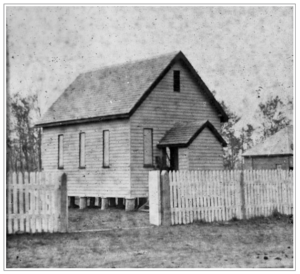
Mt Walker Congregational Church
Mount Walker Congregational Church opened in 1896. It had closed by 1940
Church of Christ (Mount Walker) (1884)
10 Hinrichsen Rd, Mount Walker 4340
Mount Walker Church of Christ opened in 1884 and celebrated its 125th anniversary in 2009.
German Baptist Church (Mount Walker) (1872)
Mount Walker German Baptist Church opened in 1872. For a time it was the headquarters for the German Baptist churches, until circa 1879 when that responsibility shifted to Engelsburg (now Kalbar) Baptist Church.
St. Patrick’s RC Church (Rosevale) (1889)
766 Rosevale Rd, Rosevale
It was designed by Father Andrew Horan and built from 1888 to 1889. It was added to the Queensland Heritage Register on 11th December 2009.
Church of Christ (Rosevale) (1896)
Rosevale Rd & Elavesor Dr, Rosevale 4340
6th October 1896 – A splendid Church of Christ is being erected on a piece of the late Mr. C. Christensen’s land, just above the “Old Station.”The many friends of Mr. Christian Christensen will regret to hear of his death, which took place at his residence on Monday morning last. He was a very old gentleman and a prominent member of the Church of Christ. Before he died he gave a handsome sum towards the erection of the new church, and worked with a will at the clearing of the ground; but unfortunately he did not live to see the church finished. He was buried on the plot ground cleared for the new church.
St. Paul’s Lutheran Church (Rosevale) (1881)
572 Rosevale Road, Rosevale, 4340
The Church was originally called St Laurentius (1881-1928) then St Paul’s from 1929 until the present day. It was served from Laidley until 1900, when it realigned with Ipswich Parish.
Baptist Church (Rosevale) (1896)
All Saints’ Anglican Church (Rosevale) (1887)
Reopened September 1929
Rosevale Methodist Church (1887)
Corner of C Zahnow Rd & Rosevale Rd.
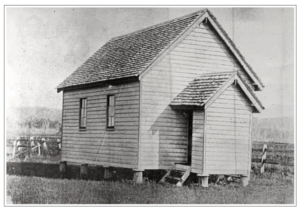 The Rosevale Methodist Church opened on Sunday, 13th November 1887.
The Primitive Methodists here for some time have been conducting religious services in the residences of Mr. D. M’Langhlin and Mr. C. Walton. Some twelve mouths ago, an offer was made by the people of this district to remove the Mount Walker church to Rosevale, and at the same time to take an old debt of £26, the residents of the above place having mostly joined the Disciples of Christ. A fortnight ago (October 31), half-a-dozen of Rosevale selectors, accompanied by the circuit minister, the Rev. C. Wesley, begin the long-talked-of task of taking the church down. The time spent in pulling down, removing, and re-erecting was just a fortnight, for, on Saturday evening, just as old Sol was sinking to rest, one of the workers, sitting astride the church, gave a loud cheer, and declared that the last nail had been faithfully driven. The whole of the work was done gratis; the gentlemen who gave their time were Messrs. D. M’Laughlin, C. Walton, P. and Z. Jehnsen, T. Larson, J. Murray, W. King and C. Christensen. The distance from Mount Walker to Rosevale is about nine miles. A half-acre of land, the best spot in the neighbourhood, is a gift of Mr. Christen Christensen. Work done, land given, deeds, transferring, fencing, &c., are estimated as being worth £42. All the necessary funds have been contributed by the people, and now, as a top stone, they are about to get up a public tea-meeting to try and wipe off the old debt of £26. The opening sermons were preached, on Sunday afternoon and night, by the Rev. C. Wesley, the afternoon service being particularly well attended. Nov 17th
[Queensland Times, Ipswich Herald and General Advertiser , Tuesday 22 November 1887, page 3]
When the Methodist congregation dwindled the church closed and congregation moved to Harrisville. The church was demolished in October 1960.
St. Peter’s Catholic Church (Grandchester) (1894)
Cnr George St & Symes St, Grandchester
On the 6th November 1894, St Peters Catholic Church was opened by Archbishop Dunne, Rev. Andrew Horan and M. Ryan. Ipswich Parish Priest, Father Stephen Bliss, held a final Mass in the old church on Thursday, 27th October 2022. Father Bliss also deconsecrated the church.
St. Anne’s Anglican Church (Hidden Vale) (1937)
Mt Mort Rd, Hidden Vale
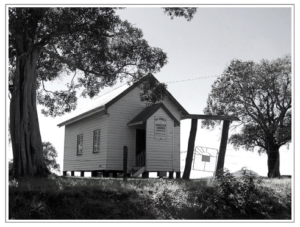
The church was built in 1937 on land donated by Mrs Cotton of Hidden Vale. The altar was built by Colin Freeman of Rosewood in exchange for having his marriage ceremony performed free of charge.
Mount Forbes Methodist Church – 1911
211-215 Mount Forbes School Road
The Methodist Church was opened on Sunday, 7th May, by Dr. Henry Youngman, President of the Methodist Conference of Australasia. About 200 people were present. The sum of £17 was collected – £7 on Sunday and £10 on Monday at the public tea meeting and concert. The church building was a wooden structure, 24ft. by 10ft., roofed with iron, and the cost was about £89/18/9. It was designed by Thomas Freeman Theaker and built by Jacob Hoffman. Before opening day £60 had been raised, so there was a debt of about £20 outstanding at the the time.
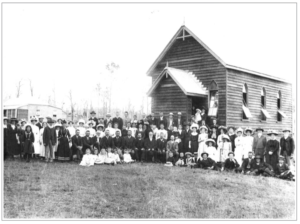
Opening of the Mount Forbes Methodist Church 1911
© Jane Schy, 2024
Published 07/02/2024