
Rosewood History
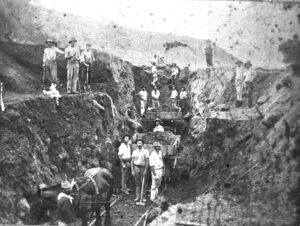
Railway workers digging a cutting for the Grandchester line.
(Photo: State Library of Qld)
RAILWAY
Ipswich to Bigge’s Camp
The first movement to establish a railway network in Queensland was met with some opposition from a sector that wanted to start a private tramway company. They opposed any measures by the Government to establish an inexpensive and light rail system. The tramway idea failed to launch and the Government put their Bill forward for a second time and it was passed by a majority of one. An appeal was made to the public and at the general election it was evident that the people wanted a railway. When looking at a map, there was no doubt how much of the State would benefit and be accessible to Moreton Bay by the construction of a rail network.
The line was to commence in Ipswich, cross over a bridge built across the Bremer River to North Ipswich, and run parallel to the river to Ironpot Creek, then follow the general direction of the old road from the One Mile Creek via Campbell’s Gully to the Rising Sun Inn at the Rosewood Scrub. Here the first railway station would be built. From there it would run through the township of Alfred and on to Bigge’s Camp, where a second station would be situated. The track would continue over the Little Liverpool Range with a tunnel at the summit of the incline, then cross the range over several gullies and ravines, through to Laidley then run parallel to to the Gatton road, across the Lockyer River on another new bridge, on to Grantham, Murphy’s Creek and ascend the Main Range to Toowoomba. From Toowoomba it would go in two directions, to Dalby and to Warwick.
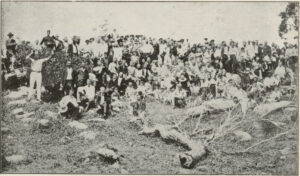
The ceremony of the turning of the first sod was held on Thursday, 25th February 1864 at North Ipswich. Lady Bowen (Governor’s wife), assisted by Hon A. Macalister (Minister for Lands), to cut the turf using a sliver spade taken from an ornamental cedar barrow. Messrs. Peto, Brassey and Co., Contractors, were assigned to take charge of the task. The photo above was taken on the day by G. H. Woodelton.
A party of about thirty ladies and gentlemen, including the Minister of Lands, Mr. Yaldwyn, Mr. Watts, Dr. Challinor, Mr. Taylor, Mr. B. Cribb, the Mayor, Mr. Thorn, Mr. Panton, Mr. S. Moffat, Mr. Willcox, and others, made a trip up the railway line on Tuesday 6th June 1865 to within less than two miles of Bigge’s Camp. The excursion was very successful, and the return journey was made under the hour.
On page 3 of the Queensland Times, Ipswich Herald and General Advertiser of Tuesday 4 July 1865 the following article appeared:
We left Ipswich on Saturday at twenty-seven minutes to twelve o clock, and at twenty-two minutes to one were opposite Cook’s Hotel at Bigge’s Camp. It is perhaps unnecessary to say that we did not travel by bullock-dray, or on Shanks’s pony, or even in an American buggy with a fast trotting horse. We went in fact by train, and, although the stoppages on the line, including that at Walloon station, occupied seven or eight minutes, the journey was accomplished in the time stated. On our return we did still better, for, though the stoppages altogether were as long, we reached North Ipswich in one hour and two minutes from the time of starting, going occasionally at the rate of more than thirty miles an hour, or from one half mile post to another in less than a minute. With the exception of the fencing and the two stations at Walloon and Bigge’s Camp, there seems to be nothing wanting to enable the line to be opened. It is true that the ballasting is not quite completed, nor the dressings of the sides of some of the embankments, but these things are by no means indispensable at first. The train ran very smoothly, and when sometimes, through the fencing being incomplete, a cow or a horse were overtaken, the engine, even when going at top speed, was stopped in an exceedingly short space of time. The country through which the line runs is tame and uninteresting after passing the first four bridges until the Rosewood is reached: here it opens out, and becomes picturesque and park-like.
Then on Saturday, 29 July 1865, page 3
Monday will be observed in Ipswich as a close holiday, and the influx of visitors from Brisbane and up-country is likely to be even greater than during the race week. We learn that every inch of space in the way of lodging accommodation has been engaged for some days past, and that the proprietor of one of our principal hotels alone has undertaken to provide beds for 150 people. The banks have given notice of the closing of their establishments, the principal retail stores have announced a similar determination, and the merchants will adept the same course: in fact, we do not expect to see any ordinary place of business open on this auspicious occasion.
His Excellency the Governor, with, Lady Bowen, will arrive today, and take up his residence at Miss Arabin’s: the majority of our other visitors will no doubt also arrive before Monday. The steamers leaving Brisbane today and Monday will issue return tickets available till Wednesday.
On visiting the station and bridge yesterday morning, we found the rails laid across the latter right up to the south end of the station, and the ballasting proceeding rapidly. This morning the locomotive will cross the river for the first time, and come into the town. The bridge and station are, however, far from being completed, nothing having been done to the former more than is absolutely necessary for the running of the trains, and the latter being still a mere shell.
The trains will leave Ipswich on Monday at 10, 10.20, 10.40, and 11, and Bigges’ Camp ore would have been invited if there had been more carriages available. The déjeuner given by the contractors will take place at about one o’clock, in a pavilion erected for the purpose at a little distance from the Bigge’s Camp station.
If the present fine weather continues, of which there is every prospect, there can be no doubt that the formal inauguration of the Queensland railway system will prove at once a most agreeable festival, and a triumphant success.
Attention is again directed to the notice in our advertising columns, specifying the time and place at which tickets may be obtained for the Railway Ball.
We are informed by Mr. Burkitt, of the Telegraph Office, that an electric telegraph station has been opened at the Railway Station, Bigges’ Camp, for the transaction of general business
Trifling as the distance is comparatively from Ipswich to Bigges’ Camp, the opening of the line even for that small section will be a great convenience to up-country travellers, who will now he able to breakfast at a reasonable hour before starting on their journey, and yet arrive at their destination its good time. From Tuesday next the coach will leave Toowoomba at nine o’clock in the morning instead of six, and arrive at Bigges’ Camp in time for the afternoon train which reaches Ipswich at six; while passengers by the up coach will leave Ipswich by the ten o’clock train, and arrive at Toowoomba, at the latest, at seven and probably much sooner.
On Monday, 31st July 1865 the first section of the Southern and Western Railway, from Ipswich to Bigge’s Camp (Grandchester) was opened by Governor Bowen.
Four trains were despatched from the old Ipswich Railway Station, situated in Ellenborough Street, and they proceeded to Bigge’s Camp via the old Bremer Bridge, Mihi Creek, and Hungary Flat (Brassall), a distance of 21½ miles (34.6km). The number of passengers invited by the contractors was limited to 500. On the day none of the trains were nearly full and could have accomodated as many again.
The following are the names of those who were in charge of the trains:-
First train-Mr. W. Brown, engineman; Mr. H. Holmes, fireman; and Mr. W. Neverson, guard. Departed at 10a.m. Arrived 11.06a.m
Second train-Mr. J. Kenna, engineman; Mr. J. Hough, fireman; and Mr. George F. Moore, guard. Departed 10.20a.m. Arrived 11.40a.m.
Third train-Mr. John Smith, engineman; Mr. C. J. Whitehouse, fireman; and Mr. J. Bailey, guard. Departed 10.39a.m. Arrived 1.15p.m.
Fourth train-Mr. Robert Lawson, engine-man; Mr. Steve Welch, fireman; and Mr. George Robinson, guard. Departed 11.00a.m. Arrived 1.20p.m. (This train conveyed the Governor & Lady Bowen and other dignitaries)
100th Anniversary of the First Queensland Railway | Monument Australia

John Smith (driver), Harry Holmes (fireman).
Standing in front L-R: left to right: J. Suett, J. Perryman, J. Bedford, W. Batchelor, H. Horniblow, J. Blythe, J. Wriggles
————————————————
The Marburg Branch
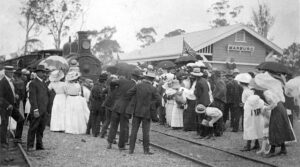
Opening ceremony of the first train to Marburg from Rosewood, 1912
Photo: Picture Ipswich
 The hopes of 30 years were realised when the Rosewood to Marburg Branch line was officially opened on 26th January 1912. A PB15 class locomotive (No 406) built by Evans, Anderson, Phelan & Co drove through a blue ribbon stretched across the track at Marburg Station, while the Marburg Brass Band, led by F. Viertel, played “See the Conquering Hero Comes”. On board were the Minister for Railways, Hon Walter Trueman Paget and local member, Henry Morton Stevens who opened the throttle and drove it through the ribbon held by Misses Ruby Heiner and Thelma Gibson. Also on board were other dignitaries and a large number of passengers who’d joined the train along the way on its journey from Brisbane Central Station.
The line was was built under the guarantee system. The Minister estimated the cost of the line at £47,721, and up to the end of December, when the work was not quite complete, the expenditure amounted to about £1,000 less than that sum. In his speech that day he reminded the residents of the district of their obligation to provide a yearly revenue of £1,410. It was their duty to provide the passengers and the produce to make the line pay, otherwise the Commissioner would have to strike a rate of 1s. 4½d. per acre.
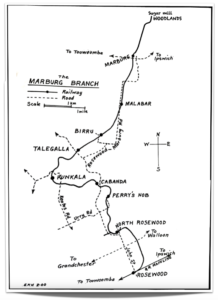
The line ran from Rosewood and took a winding course through gently rising country for the greater part of the distance, through rich agricultural land with pleasing scenery all the way. Construction began on the first 8¾ miles (14.08 klm) branch in October 1910 and it was completed to Marburg on 18th December 1911. The first station was North Rosewood, then Perry’s Knob, Cabanda, Kunkala, Tallegalla, Birru, Malabar, Marburg. During construction, the line was extended an extra mile (1.5 klm) through to Woodlands Sugar Mill.
Over the years the line proved to be unprofitabale and passengers on the mixed train could take 3 hours to get to Ipswich. The branch line remained intact until services on the section of the line from Birru to Marburg were withdrawn on 30th June 1964 and closed on 1st July. By June 1969 it was truncated back to Kunkala and by 1974 the track was effectively closed beyond Perry’s Knob.
————————————————
Rosewood Historic Railway
In late 1984 members of the Queensland Division of the Australian Railway and Locomotive Historical Society began reinstating the track between Cabanda and Kunkala as part of the Rosewood Railway. Their vision was to give visitors the experience of the late steam and early diesel era. It was a momentus occasion on 20th November 1988 when the first paying passengers were carried on DL3 “Mt Surprise”.
The last train from Rosewood to Perry’s Knob ran on 13th December 1995, when two rail-motors purchased by the Rosewood Railway were driven there from Redbank.
ARHSQD hold the lease for the line from Rosewood to Kunkala, and from January 1993 they ran trains for visitors until 2004, when operations were paused.
Kunkala Station is now the “Rosewood Railway Museum”. (57A Freeman Rd, Rosewood, Qld)
————————————————
LINKS
This is a very intersting site and worth a look for railway history enthusiasts.
RAILWAY ARCHAEOLOGY IPSWICH (QLD) – Alister J Cameron
YOUTUBE
Artist Janet Skinner interviews Dr Greg Cash, 1997 Railway Tapes Episode 7 – Rosewood Rail Museum. Janet Skinner. Romance of the Rail, History in Art and Word.
Queensland Rail – 1988 Brisbane, Rosewood, Laidley areas, VHS edit
A visit to Rosewood Railway Museum, Ipswich QLD Australia 2014
Dave & ”RED FRED” Rosewood Railway. 28th Aug. 2016
Steam train to Toowoomba part 3 (Ipswich to Rosewood) 2017
Queensland Rail’s EMU34 on Ipswich-Rosewood Shuttles 2021
Queensland Rail Vlog 60: Ipswich to Rosewood on SMU269 2021
Cabanda – Rosewood Railway Museum – Rosewood 2023
Cabanda Abandoned rail station near Rosewood QLD 2023
Rosewood to Ipswich by Train. John Coyle Video.
Trains in Rosewood, Queensland. John Coyle video. 2023
Railway Surveyors in the Rosewood District 1910

© Jane Schy, 2024
Published 07/02/2024